God and Money
 Tonight I was listening to a discussion about the just-unveiled federal budget as proposed by President Obama. In it there is the usual ‘cut the deficit by reducing services’ approach, including reducing heating subsidies. That we were assured by the commentator that these kinds of provisions would never get passed, or if they were, would immediately be set aside in a freezing emergency was not important. More interesting was the fact that cutting heating subsidies to the poor was deemed symbolic enough to be part of the budget document, an angle for the discussion about sacrifice.
This is, of course, nonsense.
The poor must sacrifice, according to House Speaker John Boehner because “we’re broke.” As my ex-wife used to say “Who’s We, White Man?” When Boehner says ‘we’, he means the federal government – the State. This can be said to be true because the federal government has never been in the business of providing an equitable and just distribution of wealth. So it is never willing to adequately tax the profits of industry for social services, even though there is no problem at all taxing the working class to provide for industrial and corporate services, like agribusiness and the defense industry. I can promise you that “we” will not be broke when it comes time for law enforcement.
Why? Not because wealthy people are exceptionally greedy and dishonest enemies of the poor, though some may be. That is a kind of comic book vision of how the world is. I have met plenty of poor people who are both greedy and dishonest. In fact, I say that human morality has little or no useful role in this discussion. This is a question of the distribution of money, and a much more primitive ~and natural~ system of behaviors is at work.
We must examine the role and functions of institutions to understand these behaviors. First and foremost, it is critical to recognize that the State is an agent of the Economy. Economics controls the State, not the other way around. Second, it is the primary business, the core function of the State to defend the interests of the Economy. In the evolution of modern Cities and States the one critical function of the Church and then the State was, and is, social order. Social welfare is considered only in so far as is necessary to maintain social order. Any idea that the State operates through any altruistic motives, as the Democratic Party would have us believe should be put down immediately. The naturally evolved nature of the State, any State, is that of Police State.
Recognizing the State as an integral part, a division if you will, of the Economy, it is possible to see the budget as a simple income and expense balance sheet. Any policy that benefits the transactional economy enhances the income side of the ledger, while the costs ~and benefits~ of social services are to be kept at the barest minimum, as that’s on the expense side – the cost of doing business. If we understand that it is the primary function of government to protect wealth, then it makes no sense to tax the wealthy! And we don’t.
So spending on war is not seen as a cost, but rather an investment in economic interests, opportunities or threats to be dealt with. Spending on health care, education and housing is considered a regrettable cost of social stability and must be ‘cut’ for the sake of ‘fiscal responsibility.’
So who is broke? The regulatory and service budgets of State. That division of the Economy is losing money, or to look at it another way, is costing the business of the Economy too much. The remedy? Cut expenditures as far as possible while maintaining social stability.
Who is not broke? The Economy that is sitting on trillions of dollars and refusing to invest. If we’re going to look at the budget, we must look at the Economy as a whole, not just at the Government sector.
So is the Economy the enemy? Well, it seems pretty clear that Capitalism is killing the planet, but it is not helpful to think in terms of enemies. It is better to examine the belief system and rhetoric that defines the mindset that makes it all possible.
When we discuss issues of society there is an enormous gulf between the realities of life and the rhetoric of society. The language of politics is paralyzed with ideologies and odd abstractions that have little or no connection to reality, except as blunt force. It is the language of sport and war, games of advantage and strategy, exploitation of opportunities. Yet on a day-to-day basis, among family and neighbors, more often than not we use far fewer words and the deep and rich complex reality is understood as a baseline of humanity.
Here is how Thomas Merton described the difference:
The irreligious mind is simply the unreal mind, the zombie, abstracted mind, that does not see the things that grow in the earth and feel glad about them, but only knows prices and figures and statistics. In a world of numbers you can be irreligious, unless the numbers themselves are incarnate in astronomy and music. But for that, they must have something to do with seasons and with harvests, with the joy of the Neolithic peoples who for millennia were quiet and human.
Merton, When the Trees Say Nothing, p.71

If you like, substitute the word un-artistic for Merton’s irreligious. For Merton, the religious mind was one of quiet observation and appreciation, compassion and gratitude; a mind that set aside all judgments of conventional worth. He certainly did not mean any kind of dogmatic theology or practice. Quite the opposite. So if ‘religious mind’ is a problem for you, substitute ‘artistic mind’ and that should work nicely.
Merton places the divide precisely at the separation of numbers (quantity) versus nuance (quality). Economics and its political arm exist almost exclusively in the abstract realm of numbers, while the all-too-real natural life of individuals, families and ecosystems exist almost exclusively in the existential realm of biology; and all biological systems are nothing if not nuanced. This is precisely why Jesus is reported to have said that we must leave for Caesar and the State that which is theirs, namely money and its calculations, and give to God and our neighbors the stuff of life, like compassion, food and shelter, health care.
In one of the most amazing short stories I’ve ever read, Atlas and the Fat Man from Behavior of Titans, Merton has the following passage:
There is another kind of justice than the justice of number, which can neither forgive nor be forgiven. There is another kind of mercy than the mercy of Law which knows no absolution. There is a justice of newborn worlds which cannot be counted. There is a mercy of individual things that spring Into being without reason. They are just without reason, and their mercy is without explanation. They have received rewards beyond description because they themselves refuse to be described. They are virtuous in the sight of God because their names do not identify them. Every plant that stands in the light of the sun is a saint and an outlaw. Every tree that brings forth blossoms without the command of man is powerful in the sight of God. Every star that man has not counted is a world of sanity and perfection. Every blade of grass is an angel singing in a shower of glory.
Merton, Atlas and the Fat Man, The Behavior of Titans, p.46
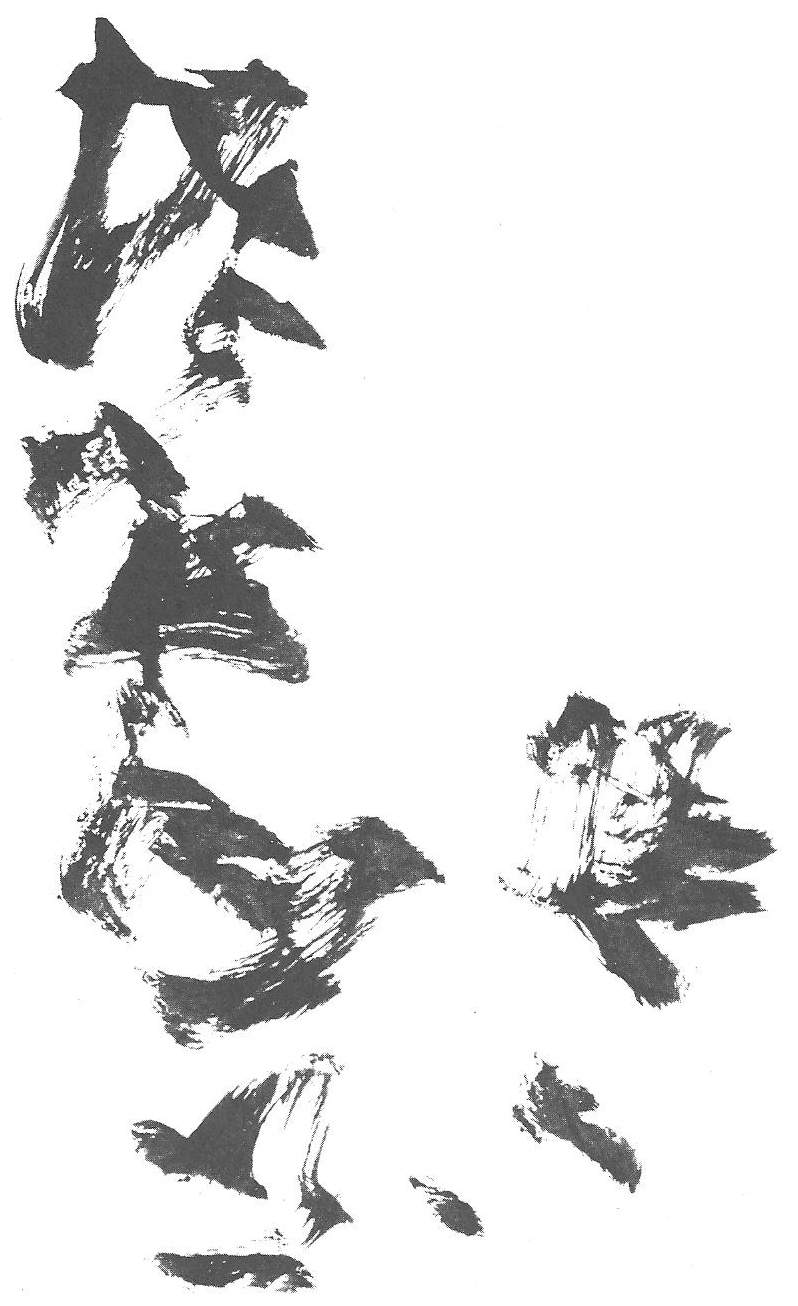
It seems to me that we have essentially a language and cognitive problem. There must soon be an evolutionary bridge, or integration between our brain functions of calculation and our brain functions of compassion if we are to survive. (Compassion means ‘to suffer together’ by the way.) Both of these functions are hallmark traits of humanity, though not exclusively of course. Note how, in the first quote of Merton’s that he himself makes this integration, citing astronomy and music as realms where numbers and reverence meet.
Jesus seemed pretty convinced that these two realms could not be bridged. Let’s hope that either he was wrong, or that he was speaking about the Current Era only.
(all graphics by Thomas Merton)
This week, we are all thinking of Egypt. After Tunisia, many commentators wondered if the ‘infection’ would spread, if strategic areas like Saudi Arabia would be susceptible to ‘contagion’. The story-line was Rebellion as a Virus. On the internet, the Al-Jazeera images immediately ‘went viral’.

from Al-Jazeera
We can think of the rebellion as social and political, and of course it is. We can say it is the eventual reaction of masses under police-state repression, and of course, it is. We can say it is essentially economic, like more food riots, and it partially is.
We could also look at it in the larger context of generalized linguistic madness, the result of a madness that exists at all times of both stability and rebellion, in all areas of human habitation. That is, a collective madness that expresses itself as various pathologies of belief, particularly the belief in dogmatic systems, be they religious, cultural, national or ideological.
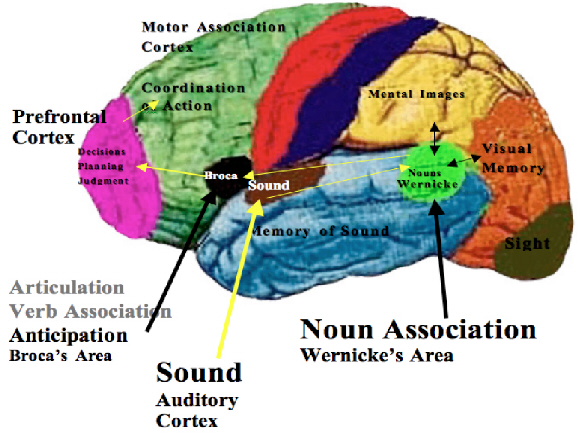 It seems to me that our brain’s language anatomy, the Broca, Wernicke and other areas near the Sylvian fissure, is in an intermediate evolutionary stage, a stage in which its development is producing both positive and negative outcomes which have as yet to be selected out. Our eyes and ears work fairly well, and we have a good idea of what to do with them. But it may be safe to say that the eventual development and proper use of our language faculty is yet unclear. In this stage, language is out of control, producing a kind of collective schizophrenia. In this stage, the most sane linguistic expressions are in song and poetry, the most dangerous expressions are in ideology and dogma; systemic forms.
With this in mind, let us remember dear friends, that our mission in this life must be both limited in scope and clearly focused. We should eschew all talk of political ‘left’ and ‘right’ as if this were some actual reality. We should understand the role of the State to be that of ‘governor’, to regulate and police. We should understand the nature of the global economy as an autonomous system, or organism if you like, which employs the mechanisms (and officers) of the State for its defense.
“Despite disparate aims and personnel of its constituent members, the underground is agreed on basic objectives. We intend to march on the police machine everywhere. We intend to destroy the police machine and all its records. We intend to destroy all dogmatic verbal systems… To put it country simple, we have heard enough bullshit.” W. S. Burroughs
To put it country simple, we must refuse to accept the existing parameters of the common discussion. To participate in the approved dialogue is to perpetuate the system that is killing the planet.
There is something to be said, as it were, to being silent. But that is not our nature. If we are not to be completely mute, what then, is the language of survival? It is dumbstruck poetry of wildness and the vast expanse, the compassion of love and loss, the disruptions of senseless joy, the great sadness of impermanence. It is the verbalization of what is real, and the unconditional rejection of any ideological concoction that masquerades as valid. There is no word for what comes next.
This, I suggest, is the natural development of consciousness, having been rudely awakened by a knock on the door, 40 years ago, by the Nova Police.
“The purpose of my writing is to expose and arrest Nova Criminals: In Naked Lunch, Soft Machine and Nova Express I show who they are and what they are doing and what they will do if they are not arrested. Minutes to go. Souls rotten from their orgasm drugs, flesh shuddering from their nova ovens, prisoners of the earth to come out, With your help we can occupy The Reality Studio and retake their universe of Fear Death and Monopoly” (Signed) INSPECTOR J. LEE, NOVA POLICE
Introduction to Salamina, without comment
IN THE WINTER OF 1932-33 affairs in America seemed as desperate as could be short of a complete breakdown of our whole industrial machine, and the chaos consequent to that. The breakdown was averted, and we enjoy today what we have termed Recovery. Yet even if Recovery be made a fact, we’d be unwise to relapse again into that unreflecting acceptance of prosperity which was, before the crash, the way of most of us. We’ve had our scare, a glimpse o fthe precarious, cardhouse nature of our social edifice; we’ve done some hard, fast thinking, most of us. What we have thought should be remembered, and in these days of change and revolution make itself a factor in our reconstruction.
It may be that we have, as individuals, no voice or choice in the directing of our national destiny; that in the aggregate we must pursue, as water flows, a course determined by the contours of necessity. Yet the doctrine of economic determinism is for from being as determinative as it sounds. What is necessity? What do we need? And if we adopted toward ourselves, as individuals, or heads, perhaps, of families, the attitude of the physician who determines what we need by what is good for us, we might find our necessities to be of quite a different order from those to which we are accustomed and for the production of which our social structure has been reared.
Of life without the luxuries that we enjoy in America, without most of the gadgets that we have come to call necessities, of life in a barren country where even bare existence is precarious and the means of getting it a hazard, this book is a record.
Introduction to Salamina, by Rockwell Kent. 1935
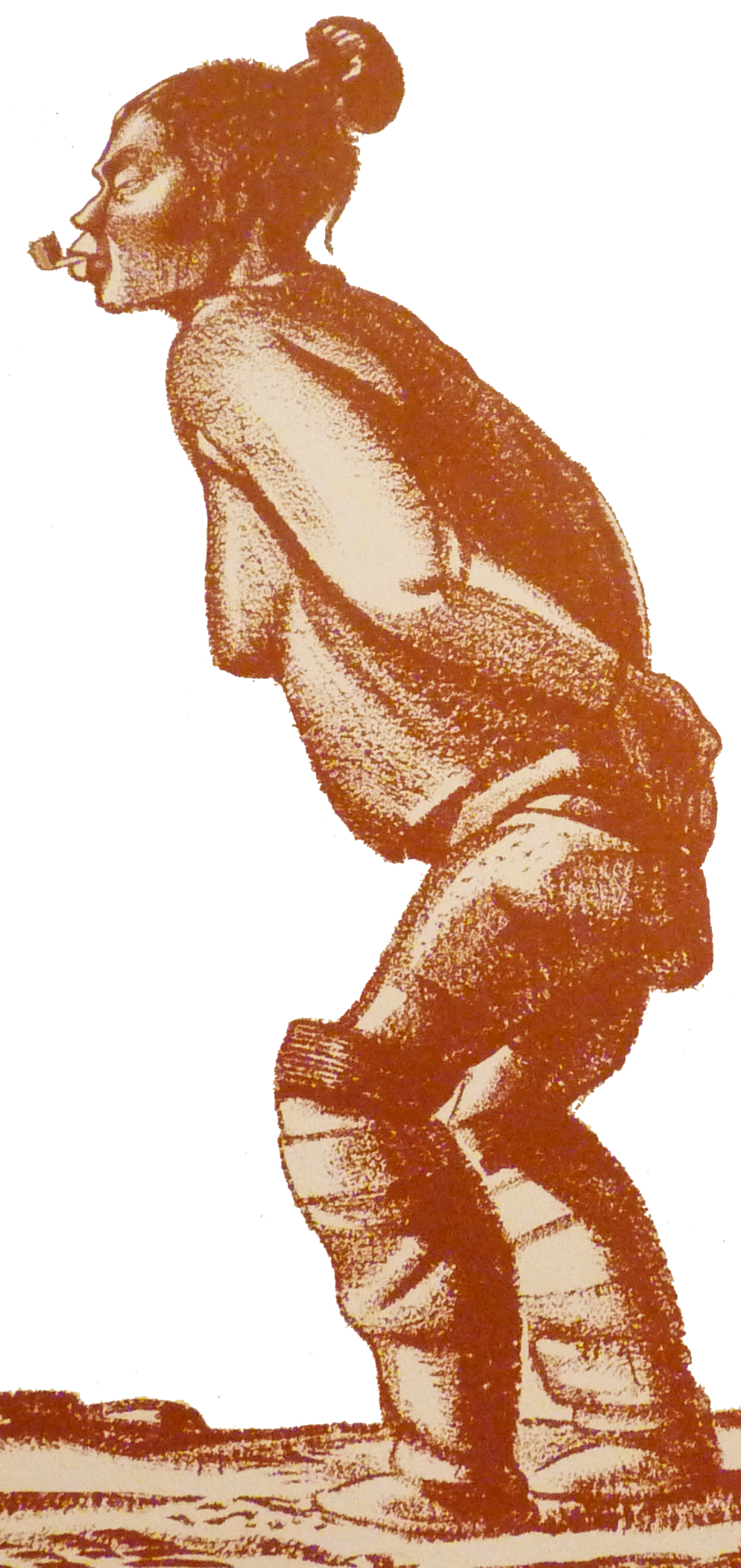
Illustrations by Rockwell Kent.

All Our Righteousness
In this wilderness I have learned how to sleep again. I am not alien.
The trees I know, the night I know, the rain I know. I close my eyes and instantly sink into the whole rainy world of which I am a part, and the world goes on with me in it, for I am not alien to it.
Thomas Merton When the Trees Say Nothing.

Paul Krugman, the economist, writes in the New York Times of January 14th, “A Tale of Two Moralities.” Two moralities, really?
Straightaway, Mr. Krugman with imperial wisdom uses the words, ever -so-casually, ‘The Truth Is…’ I suggest that anyone writing in the New York Times using those words, unless they are giving the racing results, is either disingenuous or delusional. For as John Giorno rightly says “It doesn’t matter how perfectly correct, or amazing the clarity. Everything you think is deluded.” Everything you think is deluded by your perspective. Yours, mine and Krugman’s. Perspective is distortion. Any painter can tell you that.
Krugman may understand economics on the Nobel Prize level, but he doesn’t seem to understand the difference between morality and perspective. It is the difference between sin and opinion.
 Writing in response to President Obama’s call for ‘[expanding] our moral imaginations’ Krugman immediately dismisses it by locking the discussion into the familiar bi-polar framework of a ‘Tale of Two Moralities’.
According to Krugman, by all means we should listen to one another, but when we do we will find how far apart our two ‘moralities’ are. No, Mr. Krugman, that is what you will find when what you call listening is actually a process of deconstruction for the preconceived purpose of defaming your opponent or self-aggrandizement, or both. By conflating morality with perspective, Krugman commits the common sin of elite liberalism; moral superiority.
Even in his delineation of the political differences Krugman cannot escape the confines of his own perspective. He describes the great divide thus:
“One side of American politics considers the modern welfare state — a private-enterprise economy, but one in which society’s winners are taxed to pay for a social safety net — morally superior to the capitalism red in tooth and claw we had before the New Deal. It’s only right, this side believes, for the affluent to help the less fortunate.
The other side believes that people have a right to keep what they earn, and that taxing them to support others, no matter how needy, amounts to theft. That’s what lies behind the modern right’s fondness for violent rhetoric: many activists on the right really do see taxes and regulation as tyrannical impositions on their liberty.”
This is not about policies, says Krugman, it’s about differences in the ‘moral imaginations’ of the contestants. “Regular readers” says Krugman “know which side of that divide I’m on.” Clearly Mr. Krugman implies that he is on the morally superior side of that divide and therefore by logical extension the other side is immoral or at least morally inferior. So let us ask ourselves and Mr. Krugman directly; do we believe we are morally superior to our political opponents?
But even if we clarify that we’re talking about perspective and not morality, in framing the debate so, Krugman cannot see that there are other possibilities that do not conform strictly to either his view or the view of his opponents.
Perhaps another view might be one that looks like this:
- Government is in the business of protecting the wealth of the economy by guaranteeing social stability, whether through providing security that ensures the basics of survival of a willing workforce, or, failing that, through police repression. Same as it ever was. It is not in the business of providing for the poor or unhealthy because that’s the morally right thing to do, it does so (or should) for the sake of social stability. That’s why they call it Social Security, not Individual Security. Organizations, be they governments or corporations or what-have-you, do not operate under the rules of morality. They operate under the rules of power and economics.
- People don’t want government, they want services. (John Cage)
- When people perceive that this contract of governance and taxation-for-services is not working for them, they rightly call the process of taxation theft and the process of governance tyranny.
In this view, which looks a lot like what’s going on all around us whether you’re on the Right or Left, there are not two moralities at odds, there are two, and only two, perspectives at odds on the stage of political theater. Those perspectives are generally being crafted and peddled by ‘thought-leaders’ who make their living and promote their brands through the hallowed institutions of the media which tell us who the enemy is, who the hero is, who the actors are, what the plot is, and what the plot development is likely to be, depending on their customer base.
 “Everyone says what they do is right,” quoting Giorno again. Krugman is entitled to his belief in the moral superiority of Keynesian Liberalism (which is not based on morality at all). That’s fine, it’s just more media thought-leadership. But it has nothing to do with people’s reality of unemployment and foreclosures, war and disempowerment from control over their lives.
However, couching real life complexity as a tale of two moralities? Pure arrogance.
*** All graphics by Thomas Merton, from “A Catch of Letters” by Thomas Merton and Robert Lax.
The End of Men, The End of Labor, The Overturning of Natural Order
~or~
Fear of a Pussified Planet
“Every economic system ever invented was simply a scheme to get men to work. The women have to work anyway.” ~Robert Ashley
Recently there have been many concerns raised about the ‘weakness’ of American society. There have been loud calls from President Obama’s left that he should “grow a pair.” During the recent blizzard in the NorthEast, Governor Ed Rendell decried the postponing of a football game due to weather conditions. Rendell said we had become a nation of ‘wussies’. ‘Wussy’ is, of course, polite for ‘pussy’. In short Rendell was asking the question of America “Are We Not Men?”
In an August 2010 Atlantic Magazine article titled “The End of Men” author Hanna Rosin crafts the argument: Feminists were wrong in the 80s about a natural preference for male children. She quotes Roberta Steinbacher*, a social-psychologist in 1984; “ there’s no question that there exists a universal preference for sons.” This preference and sex-selection technologies would constitute a clear and present danger to the women of the world.
*[the author describes Steinbacher as “a nun-turned-social-psychologist.” We trust Rosin’s description carried no innuendo.]
“Seldom has it been easier to disprove” those old fears of perpetual female subservience, says Rosin in her article. Citing 1990s data from fertility clinics and more recent data that shows that preference for female children runs at about 75% in the selection process, Rosin makes the case that the changing nature of the economy has reversed the gender positions. According to Rosin, the new workplace not only eliminates any advantages men might have had during the industrial age, but actually favors the female gender. “What if the modern, postindustrial economy is simply more congenial to women than to men?” asks Rosin. “What if men and women were fulfilling not biological imperatives but social roles, based on what was more efficient throughout a long era of human history? What if that era has now come to an end? More to the point, what if the economics of the new era are better suited to women?”
Is it curtains for men? Is it the end of us? Is it male destiny (as it is for some insects) to be merely boy-toys and warriors, suited only to take out the trash during peacetime?
The article is actually a good one, particularly for the employment data. Perhaps the title and approach are provocative simply to sell magazines. But my reaction was honestly one of ambivalence.
First, I should make clear my position on ‘labor’. What we conventionally call ‘labor’ in the economy is essentially an economic word for a wage-slave. A wage-slave is a person who trades time and life energy for wages, but is bound (enslaved) by the imperatives of society that require him or her to do so. That is slavery. It is my firm belief that, generally speaking, people do not want a job, they want a life. All creatures work to survive, but only humans need a job to live properly. So obviously, I’m not so concerned if the economy favors female wage-slaves over male wage-slaves. Personally I’d like to chuck it all in favor of an entirely new economic model where value is not determined by productivity and exchange value, but by creativity, imagination and use value.
In Rosin’s article “The postindustrial economy is indifferent to men’s size and strength. The attributes that are most valuable today—social intelligence, open communication, the ability to sit still and focus—are, at a minimum, not predominantly male. In fact, the opposite may be true.” Ok, the opposite may be true. I’ve already made it clear I don’t really care, but for argument’s sake and to take away any fear this discussion might raise among my masculine brothers, let’s say that the new economy is gender indifferent. This could actually facilitate a great step forward in our thinking about ourselves, men and women, because it raises the question “What are the benefits of basing my identity on gender?” If there are no economic benefits then the importance that gender plays in self-identification is diminished, and other determinants must replace it for the identity to be complete.
 What role does gender play in forming identity if we take away the economic and social roles? The most obvious one is hormonal. The chemistry produced by different sexual organs produces male and female traits on a flexible body, like voice frequency and muscle mass. Each person is more-or-less male/female as the chemistry expresses itself. I will leave the more complicated characteristics such as aggression, cooperation, empathy and objectivity alone as there is no point in getting involved in them here. The point is that, to my mind, the overall importance of gender to identity is, finally, less important than we generally think it is. Of primary importance is the statement “I Am”, and then the qualifiers of “A Man” or “A Woman” kind of recede to their secondary status as qualifiers.
Rosin’s piece contains a rather sad example of what may happen when identity, gender and economic function are bound tightly together:
“In his final book, The Bachelors’ Ball, published in 2007, the sociologist Pierre Bourdieu describes the changing gender dynamics of Béarn, the region in southwestern France where he grew up. The eldest sons once held the privileges of patrimonial loyalty and filial inheritance in Béarn. But over the decades, changing economic forces turned those privileges into curses. Although the land no longer produced the impressive income it once had, the men felt obligated to tend it. Meanwhile, modern women shunned farm life, lured away by jobs and adventure in the city. They occasionally returned for the traditional balls, but the men who awaited them had lost their prestige and become unmarriageable. This is the image that keeps recurring to me, one that Bourdieu describes in his book: at the bachelors’ ball, the men, self-conscious about their diminished status, stand stiffly, their hands by their sides, as the women twirl away. “
This tragic scene shows the dysfunction that can happen to beautiful people as the result of basing human identity on the gender roles one was born into.
So my position on “The End of Men” is that I don’t care if the economy prefers women to men and I don’t care if my ‘self’ is male or female, some combination thereof, or neither, or other. It just doesn’t matter. Most of my life is spent with books, ideas, music, a motorcycle and a disembodied internet social life where my sex doesn’t matter, and that’s the way I like it.
When thinking about this reaction to the Atlantic piece, I was constantly reminded of a famous meeting between Emma Goldman and Peter Kropotkin. Goldman, the world-famous Anarchist and (female) liberationist had been exiled and deported from the U.S. in the Palmer Raids of 1919. Kropotkin, world renown scientist (Darwin’s opposite, he demonstrated the role of cooperation in evolution) and intellectual father of Anarchist thought had been marginalized by the Communists. They were meeting at Kropotkin’s modest home in St. Petersburg (I believe). As the story goes, Kropotkin did not approve of Goldman’s emphasis on gender equality and her strident efforts on the emancipation specifically of women. Kropotkin believed that it was a distraction from the overall work of human freedom and served as a ‘turn-off’ to men in that overall effort. These two giants of the 19th and 20th Centuries argued heatedly through the night with great passion and histrionics. Finally in the early morning hours, Goldman, exasperated, shouted at Kropotkin “It may not matter to you, old man, but to millions of young men and women, the issue of sex matters a very great deal!” To which Kropotkin replied “Oh, I see.”
So I understand that my declared ambivalence toward the whole ‘End Of Men’ or the Perilous Pussification of the Planet scenario may be quite idiosyncratic on my part. Other younger lively sexual members of the future workforce may find it of great importance indeed. But remember the lesson of Hanna Rosin’s Atlantic Monthly article: “Some things that work in one epoch, don’t work in the next.”
ReEducation UnReConstructed
A great deal of my attention lately is on the nature of authenticity.
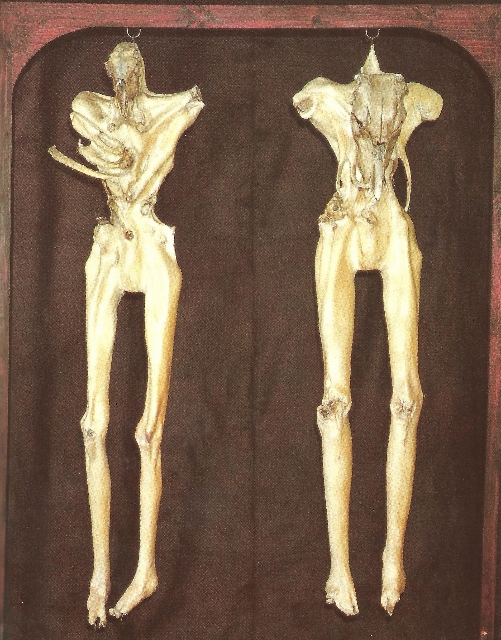
Untitled, 1982 by Jane Alexander
It is simpler to determine if something is honest, is true to itself, than it is to determine if something is authentic, that it is what it claims to be, and is original.
In a digital environment, the idea of being [an] original is almost meaningless. A copy that is a relatively close descendant of the original is a clone. But of course, as one gets further from the first iteration, anomalies, accidents, and errors occur. In a graphic a pixel gets dropped here or there during the copy or distribution process, noise is introduced and voila, we have evolution. The deviant may still be ‘honest’, that is, a faithful representation of the original, but it is not authentic.
Stories told in the analog world of griots, story-tellers, may be honest and have integrity, but they are not original. They are not expected to be. Each griot would be judged for the honesty of their report, of getting the story straight, but honor and fame came from the nuance, the depth of their presentation.
In our digital domain however, things tend to get repeated more or less exactly with little variation. Ours is an age of cut-and-paste talking points, of rigid positions passed among groups. The news ‘loop’ that plays the same 15 second visual over and over because there is no other visual information about the event that is admitted, or the technique of repeating something over and over again, exactly, with no variation or nuance until it becomes functionally valid are two technical examples. Also to consider is that in a predominantly digital domain, the presentation is flat, appearing on a 2 dimensional screen, for now. Even if we become enamored of 3-D technology, it has still only the appearance of depth. In an analog world of poetry, songs, theater and dance, all these are 3 dimensional. They have actual depth.

P.W. Botha or Haley Barbour?
So with all that said, my attention was turned this week to a statement made by John Dittmer, Professor Emeritus of History at DePauw University in Indiana on Democracy Now, discussing Governor Haley Barbour’s personal but historically inaccurate statements about the Citizen’s Councils of Mississippi. What caught my eye was the pull-quote that Governor Barbour was an “unreconstructed Southerner.”
It is of course an odd turn of phrase. I might not have been quite so interested if Mr. Dittmer had said “unrepentant.” In this case it means the same thing, but it would not contain the irony of saying that a Southerner should undergo the process of ‘Reconstruction’ in order to be made morally correct. It is the collective punishment of the South following the war applied directly to an individual in the 21st century.
Amy Goodman asked the direct, and to my mind ridiculous, arrogant and irrelevant question, ‘Is Governor Barbour a racist?’ The exact quote (as provided by their transcript) and the answer warrants posting here.
AMY GOODMAN: Governor Barbour’s spokesperson has insisted that Governor Barbour is not a racist. What do you think?
JOHN DITTMER: Well, I think when you get to labeling people racist, it’s like calling people Nazis. It’s that the conversation veers away and becomes a matter of semantics. As I said, I think that Barbour is an unreconstructed Southerner and, as such, is not sensitive to the struggles of African Americans. And there’s no indication, as governor or as president, that he would be sensitive. And I think this is the major issue. Whatever his motivations are, his conduct has been reprehensible.”
Pasted from <http://www.democracynow.org/seo/2010/12/22/barbour_is_an_unreconstructed_southerner_prof>
Excuse me? Barbour is an ‘unreconstructed Southerner’ and therefore is not, and cannot be, sensitive to the struggles of African Americans? Maybe he is or maybe he isn’t, but the extraordinary and bald-faced Supremacy contained in that twisted logic is repulsive. Or should I just say that the statement is reprehensible?

Art in a State of Seige by William Kentridge
Let no one say that I am an apologist for Governor Barbour. I have a joke that goes: “What these commentators don’t understand is that Haley Barbour wants to be President of the Confederacy, not the Union. Why would a Southerner want to be President of the North?” This is clearly a joke.
But slandering someone as a racist and declaring that they are in need of some good, old-fashioned ‘reconstruction’ or a more modern ‘reeducation’, is clearly not a joke.
In Barbour’s case, he is repeating the often heard and pervasive myth of the ‘happy slave’. In Goodman’s and Dittmer’s case, they are applying the often heard and pervasive myth of Southern inferiority in intelligence and social morality. Each is a flat, two-dimensional reproduction of 150 year-old propaganda talking points. Barbour, Goodman and Dittmer may be completely honest in their expression of who they believe they are and who their opponents are, but they are certainly not being authentic, and I suspect they know it, or at least feel it.
Professor Dittmer makes another interesting observation here, doing well as an historian, but it must be read carefully:
Cover, "Two Dogs and Freedom"
“JOHN DITTMER: Well, I think what we’re getting into here—and this goes beyond Mississippi—is that we’re getting into the sesquicentennial of the Civil War, and there are going to be—it’s going to be observed all throughout the South. And what we’re finding as historians now is that we have to go back and talk again that slavery was the cause of the Civil War. What we’re getting from many people in positions of authority in the South is, this was the war between the states. There are going to be celebrations, commemorations. And yet, the real reason for the war and the reasons why slavery existed in the first place are not going to be discussed. So this is part of a larger problem that we’re going have to deal with, I think, on a regular basis.” [my emphasis]

What Professor Dittmer is saying, and this is being echoed elsewhere – notably on the Daily Show – is that historians (and comedians) are going to have to once again reinforce the truth that the Civil War was about slavery, not State’s Rights as ‘many people in positions of authority in the South’ say it was. This is true, and the discussion of why slavery existed in the first place, and morality aside, why it was unacceptable are probably not going to be discussed.

Shaft, 1987 by Sam Nhlengethwa
So briefly here is my perspective:
The Civil War was not the start of the dissolution of the Union, but its historic opportunity to emerge. The ‘Union’ was formed as a federation of independent states which began as separate royal charters, i.e. corporations. Those favoring independence from England knew that the states must be united by what amounted to a mutual defense treaty because if they weren’t, it would be a simple matter for European powers to contest and carve up the North American continent exactly as they were doing in the Caribbean, South America, Asia and Africa. So it was necessary to work out the 3/5ths compromise as part of the power-sharing arrangement that could establish the alliance.
This unsustainable arrangement held for a while, but the contradictions between the Northern industrial economy and the Southern agricultural slave economy were unavoidable. Modern industrial economies are incompatible with chattel slavery. To the northern economy, the South looked increasingly like an undeveloped market unavailable because of slavery, and as a source of cheap uneducated labor to depress the wages of whites. (We can see this still in play elsewhere today. The first thing a modern industrial economy must do is destroy the local cooperative agricultural economy, as it did in Haiti.)
It is no accident that the secessionist movement developed in a defensive reaction to the growing industrial power of the North when the European powers in the post-Napoleonic period were in no position to step in as a foreign threat. France had just lost Haiti and been forced to sell its entire claim to the mid-continent, the Louisiana Purchase, for a pittance. Of course ‘states rights’ were not discussed as a basis for secession, but those arguments were the political vector for the defense of the Southern economy, which required slavery to function. Slavery was the economic foundation of the South. Without slavery, no significant amount of wealth could be produced from agriculture. Everywhere in the world, slavery has been the mechanism for accumulating wealth from large-scale agriculture since large-scale agriculture began. It is not a surprise that the South (meaning the economic powers in the South) wanted to maintain their economic base. And the path of ‘state’s rights’ as a political ploy was there from before Independence Day.

from Two Dogs and Freedom
We humans always want to make a morality play out of every drama, but economics and history don’t work that way; they are amoral. Both racism and anti-racism are easily fomented by opinion makers. But those moral or immoral positions are not the forces that actually move events on a macro scale; economics is.
We have no hope of changing the discourse of the people involved in generating the ideological talking points on any side of this discussion. The political and entertainment industries, the ‘politainment sector’, are moved solely by their economic interests, which are considerable. We do not have the reeducation camps or reconstruction facilities adequate to the task. But as a matter of individual behavior, I might suggest that we try to keep as much 3 dimensional, analog thinking in our lives as possible. Let us conduct ourselves with resonance and real depth-perception. And let us avoid at all costs any notion that we personally, or our side collectively holds any higher divine or moral ground than those we quarrel with, even though it may appear obvious.
Graphic Credits from top to bottom:
1. Untitled, 1982 by Jane Alexander. Wax, paint, bone, plaster of paris, wood, steel. University of Witwatersrand, S.A.
2. P.W., 1985 by Dr. Phutuma Seoka. Velvet Corkwood, paint.
3. Art in a State of Seige, 1988 by William Kentridge. Silkscreen
4. Cover of “Two Dogs and Freedom”, by Ishmael, age 14. Published by Rosset & Company, NY, 1987 (thanks Lisa)
5. Shaft, 1984 by Sam Nhlengethwa. Collage on paper.
6. Woof, by Mokgethi, age 13. from Two Dogs and Freedom, ibid
7. original photo taken atop Table Mountain, Capetown, S.A., 1990.
1,2,3 and 5 from Resistance Art in South Africa by Sue Williamson. St. Martins Press, NY, 1989.
Socialisme et Barbarie
Today on the commuter train as I continued to ruminate on last week’s Scandale de la Semaine, Wikileaks, I wondered how long it will take for Assange to be absorbed into the politainment industry. How long will it take for him to be on with Maddow, or worse, Olberman?
 The train ran down the tracks and I read the following two concluding paragraphs of Guy Debord’s Society of the Spectacle:
If the logic of false consciousness cannot know itself truly, the search for critical truth about the spectacle must simultaneously be a true critique. It must struggle in practice among the irreconcilable enemies of the spectacle and admit that it is absent where they are absent. The abstract desire for immediate effectiveness accepts the laws of the ruling thought, the exclusive point of view of the present, when it throws itself into reformist compromises or trashy pseudo-revolutionary common actions. Thus madness reappears in the very posture which pretends to fight it. Conversely, the critique which goes beyond the spectacle must know how to wait. ~Debord, Spectacle 220
Spectacle was published in 1967. Now, 44 years later it seems that the critique that goes beyond the spectacle is still in waiting, at least here in the U.S.
Suddenly, there seems to be a call for the “60’s generation” to finally do something, to live up to it’s (media revised) ideals, to overcome its 40 year malaise and address – in some spectacular fashion – the issues of economy and environment that confront us. Yet let us remember that Dr. King and his non-violent methodology did not own the political discourse or actions of the time. The Black Panthers had very different idea about organizing their communities by providing real services and real defenses of those communities. Puerto Rican nationalism moved through the bombing of Congress. At it’s peak, the anti-war movement tactics were often to shut down the government, the economy or both. Buddhists set themselves on fire. Daniel Berrigan and the Catonsville Nine poured human shit on draft records and set them afire with homemade napalm and served three years in prison for their efforts. What would be the reaction today to those actions, or even that enveloping anti-establishmentarianism that infused so much of the era? The Wikileaks revelations are a notable exception, but their activity is a release of information only, and it has not been accompanied by social action. Indeed, the most aggessive actions taken in response to the Assange arrest has been a defense of the Wikileaks technology. Yes, the electronic attacks on economic targets like Paypal and Mastercard were in support of the ideology of free information, but it is the technology of Wikileaks that is also being defended – they are inseparable.
 As Debord says (and I have been thinking a lot about authenticity lately) “the search for critical truth about the spectacle must simultaneously be a true critique.” In no contemporary search of the ongoing public dialogue can I find anything resembling an authentic critique that is comprehensively anti-establishment; one that is openly and completely counter cultural. The debate seems to be how to make the existing order either more efficient or more humane, while leaving the 400+ year old economic mentality of industrial scale accumulation and consumption intact. This behavior is not sustainable. Capitalism is killing us and socialism cannot save us.
That is not to say that there are not individuals, of course musicians and other artists who steadfastly work in a realm of anti-madness. Pauline Oliveros springs immediately to mind, and there are many others. But all seem to operate in the separated, siloed, and branded existence that is the hallmark of our epoch. The Buddha minds must be integrated.
Emancipation from the material bases of inverted truth – this is what the self-emancipation of our epoch consists of. This “historical mission of installing truth in the world” cannot be accomplished either by the isolated individual, or by the atomized crowd subjected to manipulation, but now as ever by the class which is able to effect the dissolution of all classes by bringing all power into the dealienating form of realized democracy, the Council, in which practical theory controls itself and sees its own action. This is possible only where individuals are “directly linked to universal history”; only where dialogue arms itself to make its own conditions victorious. ~Debord, Spectacle 221
Debord’s assertion that neither theory nor action, as separated phenomena, can become positively real, that is, firmly established in natural life unless they are a completely integrated whole; theory guiding action and action guiding theory simultaneously, that is precisely what is missing.
That is the sign of authenticity. That is how we will know. That is why, to go beyond the spectacle we must know how to wait for that authentic moment, like Cage Against the Machine, when the noise is the same as the music, when everything becomes melodic. Otherwise the madness reappears in the very posture which pretends to fight it.
It Doesn’t Have To be Like This
Author James Howard Kuntsler has a post today at Clusterfuck Nation called ‘The Jobs Picture’. Kind of a boring title, but what caught my eye was his statement:
The hardships of today do not represent a dip in some regular cycle of financial push-me-pull-you. This is a systemic, structural change in the socio-economic ecology of human life.
Quite right.
John Cage said around 1985 or so: “US Corporations moved into Puerto Rico and destroyed the local economy. Now the unemployment rate is 50%. The problem is they only did half the job.”

Tristan Tzara
Tristan Tzara and Richard Huelsenbeck in their 1918 Dada manifesto called for “2) The introduction of progressive unemployment through comprehensive mechanization of every field of activity. Only by unemployment does it become possible for the individual to achieve certainty as to the truth of life and finally become accustomed to experience.”
In Mechanization Takes Command Giedion points out that before the industrial revolution, people worked but didn’t have ‘jobs’. So measuring unemployment with current criteria in 1500 would show nearly 99% unemployment since most people didn’t work for wages.

Richard Huelsenbeck
In the U.S., last time I looked, about 1/3rd of the working population worked part-time. So in some sense, these people don’t have ‘jobs’, they have multiple work locations. And clearly most people now expect, and are expected by employers to exist in a fluid labor market. These things, along with the decentralization of the industrial manufacturing process are clearly moving us closer to a pre-industrial model. Updated, of course, but clearly not the present system.
An inventor in Japan has demonstrated a robot that is faster and more accurate than a human at picking strawberries. Good.
Human beings have been slaves to their conquerors since the adoption of the agricultural economy and became wage slaves in the industrial era. Now for the first time it is possible and preferable as far as I’m concerned, for the production of goods and the accumulation of wealth to occur without human labor. The trend since industrialization has been toward the devaluation of labor (and humanity, btw). This is now nearly complete, making ‘labor’ superfluous.
A 10% unemployment rate means a 90% servitude rate. The problem is not the lack of jobs, but lack of a way to live without one. “We must make the world safe for poverty” said Cage. “When can I go into the supermarket and get what I need with my good looks?” asked Ginsberg.
“How do we find a new way to value human beings, now that they are worthless?” I ask. Or, “I don’t want a job, I want a life.”
Kuntsler envisions a neo-agrarian society, but I can’t see it. When we evolve we never reclaim the past, but a new structure emerges directly from the attributes of its predecessor.
As Debord says “It is obvious that ideas alone cannot lead beyond the existing spectacle; at most, they can only lead beyond existing ideas about the spectacle” (Debord, Spectacle, 203). We can conjecture all we want, but no ideas that we now have can possibly describe what a new social and economic structure will be like because we haven’t made that move yet.
But what we can say is that it hasn’t always been like this, it doesn’t have to be like this, it can’t continue to be like this, and whatever happens will come from this.
Ah Pook and the Internet Gods of Gold
Two odd videos were posted today by separate FB friends, strangely related by the common theme of ‘threat by unseen forces causes mayhem’; The Madness of a Lost Society and, from a completely different worldview, Flash Mob Gone Wrong.

Lindsey Williams
The ‘Madness’ case, set on Black Friday in a shopping mall near you, crazed consumers mindlessly rush for discount holiday bargains. “Is this what we’ve become? How many of them have an ounce of silver in their possession?” In this story we have the familiar tale of populace as the dupe of hidden elites, who control the money supply, the energy supply, the media feed, the food supply; you get the picture. Doing the trackback on this video, we get straightaway to Pastor Lindsey Williams whose message is, surprise! Elites control the money supply, the energy supply, the media feed, the food supply, the Devil’s Messiah is coming within two years and you’ll get no supper, etc. Will YOU be prepared when the masses can’t get what they want? Owning silver, plenty of ammo and some vegetables is your best defense.
In the Flash Mob case, which is told as a piece of clever fiction but is nonetheless a depiction of our information-only reality, a flashmob develops through a series of coincidental connections and ends up as a riot that leaves a couple dozen dead in a peaceful London suburb. The unseen force in this case is the ‘butterfly effect’ operating on human beings via the web, and since we’re completely unable to control our behavior, or are controlled by matrix-like hidden programs, mayhem ensues.
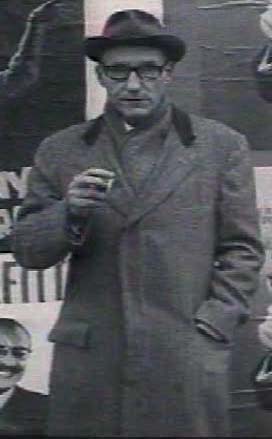
William S. Burroughs
To work as plausible stories, both of these scenarios rely on the primary fear of something unknown, lurking, waiting to destroy us and our homeland as we know it. An infantile fear of monsters, but effective nonetheless.
Fear of ignorant mobs made crazy by hidden overlords, or the violent mob brought together by hidden technology, the result is the same: isolation and separation, a search for psychological safety.
Ah Pook is Here. Suicide is inevitable.




 Pax Lupo
We Went There, There We Were, and all the While, Elsewhere too.
Pauline’s music was part of a concert of modern music put on by the Florida International University music department; special hat tip to Paula Matthusen and Orlando Garcia. There were two pieces of Pauline’s, “One Hundred Meeting Places” and “Tuning Meditation” which I particularly liked. “Tuning Meditation” was quite beautiful, an enveloping bath of harmonic sound without rhythm. “One Hundred Meeting Places” was more cerebral, having to do with the juncture of neural ganglia at the top of the skull. The piece incorporated a visual (theatrical) aspect in that the ‘score’, consisting of the time fragment delineations of the piece [numbers], were projected on a screen behind the musicians. “You know,” I said to Pauline, “That piece is completely different without the visuals.” “Yes,” she said. “Completely different.”
But what really has lingered with me is her briefly talking about how difficult and important it is to try to write about or talk about or actually think about things that right on the edge of one’s understanding, just slightly beyond your grasp; what you are not sure about, what you can be wrong about, what you may completely misunderstand. It is this process of working with those ideas that you don’t fully understand that is the ephemeral substance of our life’s endeavor. It is consciousness trying to live.
But it is this study, this thinking that is right on the edge of what can be conceived and codified that is so important.
Then, it is also understanding that, once reasonably codified: “No matter how perfectly correct, or amazing the clarity, everything you think is deluded. Everything you think is deluded. Everything you think is deluded.” ~ John Giorno
Share this: