Buddhist Reincarnation in Six Obvious Steps
Buddhist Reincarnation in Six Obvious Steps
- 1. You’re born.
- 2. You spend a lifetime making a gawd-awful mess of things.
- 3. You die.
- 4. Another iteration of your form emerges into the previous mess you made.
- 5. Since you don’t remember a thing, you blame the mess on everyone else.
- 6. Go to step 1.
Like it? Tip it! http://smalagodi.tip.me
Music is Worthless
Music is worthless. Perhaps that is as it should be.
It is as worthless as the swallow-tailed kites above Arbuckle Creek; as worthless as the free wolf in the mountains, howling. Who would pay for the flight of a blue heron or hawk, unhindered over the Everglades? These things are wild and uncaptured and therefore free and worthless.
The great composer and writer and trombonist George Lewis once said to a friend, the singer and performance artist Jill Burton, “No one pays you for the music. They pay you for what is said about the music.” This was a kind of confirmation to me about a line of thought that said “music is a kind of thing that is never compensated.” Indeed, it is the kind of thing that cannot be compensated, because by its very nature, it cannot be traded or exchanged. It is a phenomenon – or one aspect of a collection of phenomenae – completely temporal, “free”, and impossible to hold. What is bought and sold however, is access to the social container where music occurs, either directly in the case of the venue such as the opera house or concert house or whore house, tavern or theater, or indirectly as the container’s efficacy as a symbol of class, or tribe or religion or as a subject in an academic paper.
The distress and resentment I often see, and have experienced myself, over the plight of musicians; disrespected and insulted at every turn, comes perhaps from this confusion over the unbridgeable difference between intrinsic value and social value that becomes eventually, value in money. One need only to look at the myriad examples of commercial music encountered everywhere that we would say, quite rightly, have no intrinsic value as music and yet which garner mansions worth of fortune for its traders, while other music, astonishing in its beauty and luminosity, often literally, goes for nothing. Now it may be true that over time the practitioners and admirers of such sound may eventually come to some acclaim, but it will be because, as Mr. Lewis points out, because of what is said about it (its symbolic container), how it references a lifestyle, such as hip hop, or cool sophisticated jazz, or the progressive-hip lifestyle of a ‘cutting-edge’ cognoscenti of the downtown art scene; social value derived from the conference of an identity. These things are the packages, the containers, the fashion styles which only reference something completely different – the music itself which they invariably fail to capture. Perhaps, to use a cliché, it is like the finger pointing at the moon. We pay for the directions, the signage, but we cannot pay for the thing itself because it is beyond the realm of compensation.
Perhaps this confusion as I see it has been exacerbated by recording technology which claims to ‘capture’ sound in a device, giving rise to the increased commerce around the (sadly deficient) representation of the original event. In this case it is natural that composers and musicians are concerned with their share of the commerce from the sale of the replications, which only mimic the original event. (Wasn’t this Warhol’s point?) The composer who never performs sells only the guide to the realization of the sound, and the cache that surrounds it. It is my contention that, in the United States at least, compensation to artists is given – when it is given at all – as an exchange for the labor of its manufacture, and with little regard for finese. It is my understanding that BMI has different compensation scales for so-called ‘classical’ composition – that is, music with roots in the European Imperial court, and another much lower scale for everything else. This blatantly racist structure makes it pretty clear. When your work is part of an industrial process and your collar is anything but White, expect to be paid, and cheated, as a laborer.
I once was trying to describe my position to a venerable Buddhist jazz musician who rarely works. “Look,” I said, “We are beggars or something like monks. We walk into town with nothing but our rags and our begging bowls and our wisdom.” “No!” he cried, demanding respect for his talent and the sacred history of his profession. It shall never be. The profane has no bridge to the sacred. They are separate worlds. One is the realm of Caesar the other is the realm of the saints. Each is worthless to the other.
“America, when will I be able to go into the supermarket and get what I need with my good looks?” asked Alan Ginsberg. The question is when will the intrinsic worth of beings freely born into creation transfer into food from the supermarket without effort or explanation? I am not holding my breath. Not with the devil running things the way they are.
John Cage said “When you separate music from life, you get art.”
Thomas Merton said “There is another kind of justice than the justice of number, which can neither forgive nor be forgiven. There is another kind of mercy than the mercy of Law which knows no absolution. There is a justice of newborn worlds which cannot be counted. There is a mercy of individual things that spring into being without reason. They are just without reason, and their mercy is without explanation. They have received rewards beyond description because they themselves refuse to be described. They are virtuous in the sight of God because their names do not identify them. Every plant that stands in the light of the sun is a saint and an outlaw. Every tree that brings forth blossoms without the command of man is powerful in the sight of God. Every star that man has not counted is a world of sanity and perfection. Every blade of grass is an angel singing in a shower of glory.
…
The gentle earth relaxes and spreads out to embrace the strong sun. The grasses and flowers speak their own secret names. With his great gentle hands, Atlas opens the clouds and birds spill back onto the land out of Paradise.” ~ Thomas Merton, Atlas and the Fat Man, The Behavior of Titans
What is it that you expect from music, anyway ?
Like it? Tip it! http://smalagodi.tip.me
Miami – the Real Follywood
Has South Florida Displaced Los Angeles In The World Of American Crime Fiction? ~by Nathaniel Sandler
http://www.wlrn.org/post/has-south-florida-displaced-los-angeles-world-american-crime-fiction
A Response:
Ah, probably not. Or maybe so. Not a concern of many.
But honestly, this post raises a couple of other more worldly questions. Is this piece, posing as literary criticism, a contribution to WLRN’s Florida-glare treatment of ‘the arts’ in South Florida, or is it yet another prop for boosterism? I think the latter. Is WLRN capable of publishing anything other than boosterism? Probably not, given the entanglement with the Miami Herald which, at least since the killing of the Miami News, functions principally as the publishing arm of the various Chambers of Commerce.
The justification: “but it’s worth exploring to better understand the lineage we here in South Florida share with written crime narratives as well as various slinky women with muscle-bound henchman at their whim and/or tails.” No it isn’t worth it.
The argument: “there are a lot of moments where Gopnik’s brilliance just doesn’t get it.”
What doesn’t Gopnik get? According to the latest generation of boosterists, when Gopnik and people like me say “the system is fake”, we just don’t understand that in Miami, that which is fake is the substance of our authenticity. The ubiquitous ocean of fraud, corruption and (self) deception in which we swim is the very domain of our existence. The wholly artificial and unsustainable fabrication of Greater Bloated Miami, in both its physical aspect and its mental self-conception, is the very essence of who we are. In this respect the comparison of Miami to Hollywood (not LA) may be of service. But at least Hollywood understands at some level that it is fiction. But wait, people like me don’t get it. We need to dig deeper. When you dig into Miami, you get water and/or broken sewers.
The story of Greater Miami as a viable, sort-of-grown-up city is a fiction. One need only look at another piece also published by WLRN on its website asking, much too late, what ‘solutions’ might be found for South Florida’s rising sea-level troubles. http://bit.ly/11o9VRU The piece lays out, again too late, all the options that won’t work to save Greater Miami from reverting to its appropriate size for human habitation (about half as big as it is now). But it studiously avoids the “R” word, a word that is being openly discussed in other mature cities faced with this same crisis, like Bangkok, where the Relocation of hundreds of thousands, perhaps over a million residents is discussed as probably the only realistic option that they have. But no solutions are offered in the WLRN report as there is only one; the relocation of much of South Dade. But we are a people who regard realism as an unwelcome and decidedly unfashionable buzz-kill. Boosterism keeps the economy afloat on nothing more than a lilly-pad and a lot of drugs.
This is the story of Greater Miami exceptionalism; a myth of being special, just because we believe we are. Boosterism can work for a while, just like every other kind of charlatanism. But sooner or later the charlatan must get out of town or face the consequences of lies and deception. The great self-deception here is that our industrial machines can do what no civilization before even tried to do – build a metropolis in Miami on a flat foundation of limestone and hubris. Wrong. The ocean wins. Mayans, Aztecs, and every other people who came before us understood this. We understand nothing except intoxication.
“Inform, Entertain, Inspire”; that’s the essence of boosterism.
 *Oh, and by the way… The closest the 9-11 terrorists came to training in South Florida was a few hours in a flight simulator. Their flight schooling was in Venice, Pensacola, Arizona and California. If you wanted to make an argument about terrorists in South Florida there were plenty who were actually based here; Cuban and Nicaraguan terrorists. The training camps were here, not so hidden in the Everglades. The bombs blew up here. Alpha 66 had an office on Calle Ocho. (Now closed but still bearing the signage.) People like me were assaulted here. But that’s not to be mentioned by boosterists; it doesn’t fit the fantasy.
Like it? Tip it! http://smalagodi.tip.me
This is not Times Square
I know nothing about modern art. My visual sensibility ends in the time of Man Ray, that straddling of eras between the bio-centric and the wholly industrial. Charlie Chaplin. That time between when men were the instruments of war and the time when machines took that job and all the others anyone still talks about.
This retardation is not so bad though with my connection to modern music. I have a pretty good sense of it, and tend to favor the jazz-rooted, improvisational avant-garde over the avant-garde constructions of what can be said to be coming generally, I said generally, from the modern Euros.

Nevertheless, Brook Dorsch was opening his new Emerson Dorsch gallery in Wynwood, that area of obsolete textile and shoe factories being taken over by the new Creative Class, or rather by artists who will provide the suitable ambience for the Creative Class once the conditions are just right. Dorsch and his gallery had just been the focal point for an article in Atlantic Cities, a web publishing division of Richard Florida’s urban planning venture centered around this meme of the “creative class”. The author, Alesh Houdek, tells the story of respectable art gallery pioneers disgusted with Miami’s drunken party animals who have followed the scent of alcohol and hipness to Wynwood’s art walk event. “Bristling at their own success” was the title. This is a problem because R. Florida’s Creative Class needs a proper setting for creating wealth, a setting which needs to be more like a sedate café than a wasted rave. But I digress.
Anyway, a friend of a friend, Rene Barge, had a sound installation as part of the opening so I decided to go. Being weary of the 50 mile drive to Miami, I set off on TriRail for the gallery. TriRail to MetroRail to the #2 MetroBus; no problem really when you’re tired of driving.
The Emerson Dorsch Gallery is a well done factory conversion in the style of modern galleries. Everything is hard and white; hard floors and hard angles of the hard walls and ceiling. Every sound ricochets a hundred times before its energy fades, like light in a house of mirrors.

I arrived early, before the art lovers, who were also mostly angular and white; early enough to be able to hear Rene’s work reverberate through the gallery, as it was designed to do. The stereo piece was made of material sounds captured with contact mics and processed through computer modules to produce a field of static sound overlaid with longer waves that, maybe through phase interactions, oscillated over the static wall. It was one of those architectural pieces, à la Alvin Lucier or David Dunn – with whom Barge is a collaborator – which does not call attention to the composition, composer, instrument or auditor, but rather is designed to give information about the space it is in, much as a bat navigates a cave. It works well in the empty gallery, but is impossible once the chattering gallerists arrive in numbers, who are of course all chatting and not listening. We are a species of chatterers, not listeners, as the Buddha suggested.
 The installation of Barge’s instrument is one of the few things in the gallery not hard, angular and/or white. Two arcs of bent plywood with belts of red fabric serve as bells or cones for what appear to be bass or sub-woofer drivers (without their normal cones) which act as the speakers for the ipod containing Barge’s materials-derived music. This is the installation, architectural enough to engage the visitors (briefly) as they go about their visit. Of course they care nothing about the sound; it’s not really necessary.
 The other major work in the gallery is that of Brookhart Jonquil, of which I can say little other than my direct observation. Besides, the installation entitled “In a Perfect World” has a printed program of explanation far more in depth than I would ever attempt, and which I have not read. The pieces are large constructions of steel frames holding angled, irregular rectangle sheets of mirror which extend outward from a central, flat white surface of a simple two dimensional geometric shape; oval, rectangle or triangle. Each assembly is traversed by arching and curved steel rods which continue through the mirror walls to the frame, or to the gallery wall itself to which the whole assembly is mounted with industrial hardware. Viewed straight on the pieces gave me the feeling of portals into which the viewer could be drawn and travel through to the white space beyond, where perhaps this perfect world exists. Viewed from an off center angle however, the mirrors produce the illusion of intersecting planes of separate universes. The flat white surface in the center of the structure becomes in appearance a three dimensional object; cube, sphere, or pyramid. The structure becomes an illustration of advanced cosmology, multiple universe theory, intersecting planes of space-time.
After a while the gallery filled with gallery-goers and the reverb of their unstoppable conversations. Needing to catch the last Tri-Rail north lest I spend the night wandering the foreign streets of Hialeah, I said good bye to my friends Gustavo and Claudia, who arrived late. I walked across to the bus stop at NW 2nd Ave and 25th St., past the Creative Class Café (not its real name) to wait on the corner for the next southbound #2 bus. Two white women passed by, talking about someone else who was an asshole. A car blocked the street briefly, the backed up car horns sounded, the finger got flipped. A collar-less dog darted through traffic to come smell the grass near the sidewalk. Two young black boys on bicycles, possibly adventuring up from Overtown with nothing better to do on Friday night, wove up the street studying the Creative Class conquistadors.
The bus arrived. It is a moving box full of tired but jovial workers, all Black and Brown and fleshy. There is absolutely nothing hard, white or angular anywhere. But two young white girls do sit in the very back corner, which, post Rosa Parks, is where white folks tend to go when in a bus full of black people, generally speaking. In every bus in Miami-Dade County, there is a seat in the very front dedicated with a plaque to Rosa Parks. I like to sit across from that seat to see who sits there. These are the workers and the descendants of the workers who used to tend the machines in those factories that once made shirts and shoes, but now make artistic ambience. Those machines moved far away, beyond the range of the municipal bus, where the space and the attendants who feed them leather and fabric are cheaper. These are the workers who constitute what Richard Florida calls the Service Class, but I call them The Servants just for the effect. And besides, a servant is at least human, whereas a class is a mental category. Somebody’s category.
It took me less than 5 minutes to go from the one universe of the gallery to the other universe of the bus. Perhaps, if I can find a perspective that is somewhat off-center, I can see how these universes intersect. Right now though, I can not.
Like it? Tip it! http://smalagodi.tip.me
Covering Up Exxon’s Mayflower Mess
On Sunday, April 9th, I, like many others concerned about the Keystone Pipeline and the impact of tar sands on local and global environments, had been following the events of the Exxon Pegasus Pipeline spill in Mayflower Arkansas for over a week. Most of the information about the event seemed to be coming from alternative social media sources rather than mainstream news organizations. Some of those sources were describing the scene as ‘something like martial law’. I know what martial law looks like.
It came to my attention early Sunday that a former colleague, Michael Hibblen, who is now the News Director at KUAR in Little Rock, was reporting on the story for his station and for NPR. I decided to call him to ask for an interview about his experience trying to cover the story. He graciously agreed. What follows is a condensed version of that phone interview. A complete, unedited transcript is available on request, and a completely unedited audio file of the interview is available at http://snd.sc/10Nt6jo.
There are a lot of details here, including the details of Mr. Hibblen’s near arrest by Deputy Sheriffs apparently acting on orders from Exxon.
While there is often much – and well deserved – criticism of mainstream media, I think this conversation with Mr. Hibblen illuminates very well, in a very honest way that is not often committed to print, the difficulties faced by a shrinking and impoverished set of local journalists trying to do their work with very few resources, mostly indifferent civil authorities, and enormously wealthy and secretive organizations.
STEPHEN MALAGODI INTERVIEWS MICHAEL HIBBLEN
SUNDAY, APRIL 7, 2013
CONDENSED TRANSCRIPT
Stephen Malagodi: Michael, you’re the news director at KUAR in Little Rock. We met when you were at the Miami Herald, and you have since moved back to Little Rock, and you’re from Arkansas, so it’s probably safe to say you have some feeling for the land of Arkansas itself.
Michael Hibblen: Sure.
Stephen Malagodi: How did you first hear about the spill?
Michael Hibblen: We got word of this late Friday [03/29] afternoon, about a week and a half ago… we saw a news bulletin I think from one of the TV stations and that’s when we reached out to Arkansas Department of Emergency Management and learned that a pipeline had ruptured, apparently spilling oil into a neighborhood, and that’s when we started reporting on it.
Stephen Malagodi: So you called Arkansas emergency management. There was no initial communication out to the media from them to you?
Michael Hibblen: No, we reached out to them before they even had a chance to send out a press release or anything like that. It was late Friday afternoon, so most government offices were closing or had already closed and I ended up reaching out to the county judge for Faulkner County. That’s where this happened, north of Little Rock… [condensed for length] …and I sent him an e-mail, heard back from him later that evening, and the first time we got any kind of confirmation on tape was talking with him early the next morning [Saturday 03/30] before we started our Saturday morning newscast, and at that point his main message was it could have been a lot worse. …[condensed for length] … and Monday finally I got over to the site where this was happening, a small town called Mayflower, and at that point I was able to talk with a spokesman from Exxon Mobil and the county judge, and at that point this wasn’t getting a lot of attention. This was pretty much being looked at as a fairly minor oil spill, but as the story continued to progress, the residents – there were 22 home owners near where this pipeline ruptured who were evacuated. They had initially been told it would only be a couple of days. Here we are now nine days later and they’re still evacuated. And as this has gone on, more questions have been raised and as more media have shown up to see this, there was more and more of a reluctance on the part of Exxon Mobil or others to let the media in to view the site. Most of the footage and photos that we got came from the same day that the accident happened. After that, it was basically you had a checkpoint at the entrance, only one entrance to this small neighborhood, and from then on you had the local county sheriff’s department running the checkpoint as Exxon Mobil oversaw the cleanup in conjunction with local emergency officials, but at that point you started hearing less, especially from Exxon Mobil, in terms of media availability. Beyond that, Monday [04/01] when I spoke to one spokesman for the company who expressed how sorry they are for the accident, how they were going to make sure they did what it took to clean the spill, take care of any expenses, pay for any damage. But from then on we didn’t hear as much from Exxon Mobil.
Stephen Malagodi: How did you make the decision to allocate resources, probably yourself, to make that trip, an hour away from Little Rock, up to Mayflower on Monday? In other words, how did you know the story was big enough to allocate those kinds of resources to it, on Monday?
Michael Hibblen: Well clearly, as we were getting more word of the volumes of oil, or the tar sands as it’s called, that had spilled, clearly we knew that this warranted more attention. We have, like a lot of news departments, very limited staff on weekends, but on that Monday, talking with my boss and all, we pretty much knew that we needed to go up there, try to get some residents, try to get some essentials, and do more than just talk to the county administrator. So that was when I went up there. I had apparently just missed an availability where they had brought in some reporters [who] didn’t get very far into the neighborhood, but at least gave them from down the street a shot of what was happening, but I was at least able to talk to the spokesman for Exxon Mobil at that point and get more tape with the county judge.
On Wednesday [04/03], we had gotten word from the Attorney General of Arkansas, a Democrat named Dustin McDaniel. He was launching – he decided to launch an investigation looking into the cause of this spill and also how it was being handled, and he had become more critical of Exxon Mobil … [condensed for length] … and so he was going to be going up to the site along with state officials and attorneys from the Attorney General’s office along with investigators as they launched an investigation into this. They also issued subpoenas and ordered Exxon Mobil to preserve all documents related to this. Well, Wednesday when he was going up to do the tour, I had spoken with the spokesman for the Attorney General’s office and he told me that they didn’t mind if I followed him around as they toured the property, but it was still the county that was essentially controlling security in and out of the area. Following the Attorney General’s motorcade, I was able to get in as a member of the media, as were several others. We parked, got out of our vehicles and went over to the site that the Attorney General was going to be touring. At that point the county judge told us that in terms of liability, we were all on our own, we were there at our risk. We were also told that you have to stay in this small area. You can get shots and follow from a distance, but you can’t go beyond a certain post that he pointed to, and we were all, “That’s fine.” We all agreed with that. And then as the Attorney General started walking through, it was about 90 seconds into his tour as we were just kind of following him from a distance, that suddenly deputies with the Faulkner County sheriff’s office started yelling, “Exxon Mobil has decided they don’t want you here, so you have to leave immediately.” Some reporters began questioning, “Well, who made this decision? Who can we talk to about this?” At that point the deputies began saying, “You’ve got 10 seconds to leave or you will be arrested.” And a lot of us had problems with that, but in my case NPR was waiting for tape for a piece that they were putting together on this and I had a deadline to get stories fed and together for our afternoon newscast, so the last thing I needed to do was to make a stand and not get tape to the people who were waiting for it, so at that point I left. There was no one from Exxon Mobil there to speak with us on that day, Thursday [04/04] and Friday we didn’t hear anything back, and it wasn’t until today [04/07] that I found out from a secondhand source, another reporter friend, there wasn’t a press release put out, but they did open up the site for the media to come in and for us to finally get a firsthand look at the cleanup that was underway. I should also mention, there was the FAA on Wednesday [04/03]. They ordered a No Fly Zone around the cleanup site, apparently at the request of Exxon Mobil, and it came after the local NBC affiliate had flown a helicopter overhead and they were told to get out of this space and from between Wednesday and Friday there was that No Fly order over the neighborhood there. Then that was lifted on Friday [04/05], and as I said, today [04/07] they finally let the media in and they walked all of us through the neighborhood from a safe vantage point but fairly close to all of the areas connected to this cleanup. … [condensed for length] … They also showed us the places where the oil went down a roadway. … [condensed for length] … But we finally were able to get in and take a look at the site today. But it’s been nine days.
One person who had reached out to me who had heard about the limited access to the media was with the National Press Photographers Association, and as he told me on the phone today, “Well, they’ve had nine days to clean up or hide or do whatever they want. It’s not enough nine days after the fact to now open it up and say that you’re being open with the media.”
Stephen Malagodi: Let’s just back up a little bit to the incident with the Attorney General. Now, you said that after just a short while the local sheriff’s department deputies told you you had to leave, and I guess you were threatened with arrest if you didn’t leave. You said that the deputies said that Exxon had decided. But you also said that there was no one from Exxon on site. So was it completely unclear as to where that order came from?
Michael Hibblen: There – yeah… It probably was someone there but just no one was made available to the media. …[condensed for length] … but I’m just speculating, but, yeah, in fact they even said at one point, “Exxon Media wants you out.” Well, what’s Exxon Media? And they… clearly someone had decided only shortly… and I was recording as the tour was going on so I even was able to check the time and see it was about 90 seconds after we had agreed to the conditions with the local administrator up until suddenly we were told, Exxon Mobil does not want the media here. But it was mainly just that they [Exxon] did not have anyone, they didn’t make anyone available to the media or want to offer any justification or allow anyone who media could argue with about this.
Stephen Malagodi: Yeah. And it’s, you know, understandable, you were under deadline and it’s never any fun getting arrested, but it wasn’t a crime scene, or there didn’t seem to be any danger. … You went to journalism school at the University of Arkansas, I believe, in Little Rock…. How do you train for these kinds of situations where there doesn’t seem to be any legitimate authority behind what someone is telling you to do. In other words, even if it wasn’t a deputy sheriff, it could have been … a security guard who has no real legal authority [saying], “You can’t be here.” Well as a journalist, how do you make that decision about who’s got authority and is it legal for you to do what you’re doing?
Michael Hibblen: Yeah. Well, it was an emergency situation and is still considered such and they do have the whole neighborhood cordoned off, so I think it is about the equivalent of a crime scene just because they do consider this still an ongoing emergency. So at that point it’s, – my initial reaction was, “Well, this is a public street.” But they were saying, you know, “No, this is, you know, we are dealing with an emergency here.” There may not have been any impending danger at that point, but clearly there are issues when you’re not allowed to even enter the [area], especially as I said after the county administrator, who’s one of four people overseeing this, laid out the ground rules for us about liability and where you can be, we were all fine with that, and we were just going to watch the Attorney General from a distance and then talk to him afterwards. So at that point, just because – and he was already running late, and NPR was already getting antsy because it was getting later and closer to their deadlines. At that point we all pretty much decided, okay, we’ll go ahead and get out of here. We’ve got some footage, and we did speak with the Attorney General afterwards over at the City Hall in Mayflower. But it is a good question and it was a hard call to make, how much more do you argue about this? Listening back to the tape of it, I had set my mic down. I had a shotgun mike that I was using, but I also needed to get photos for our website, so I had set it down and left it recording so I at least knew the timeline then. … [condensed for length] …
And I should point out too, the Attorney General pretty much accused Exxon Mobil of trying to kind of control how he was handling that. He said when he got there, they wanted to put he and his investigators into a van and take them on a tour, and his exact words pretty much were, “I’m not here for a tour and I’m not getting into a van driven by one of you. I’m here with my investigators and we’re going to go here and take a look at this ourselves.” So it’s clearly an attempt by Exxon Mobil to control not only the media but also to try and perhaps corral the Attorney General, at least limit him. And he was like, “And I’m the attorney on behalf of the state of Arkansas and I’m here to look out for the interests of the residents and the people here. So, no, I’m not getting into a van driven by one of your people, I’m here to see for myself.” And I think perhaps he was since told that [that attitude] made Exxon Mobil more defensive in this. … [condensed for length] … While the local county sheriff’s department was controlling the scene, clearly from that initial response, and maybe they may have even wished they didn’t say it like that, but that pretty much gave the impression that Exxon Mobil was calling the shots and was controlling the scene.
[condensed for length]
Stephen Malagodi: Right. So, as far as communications is concerned, does Exxon Mobil have its own communications operation and the civil authorities have their communication operations, or is there a unified communications center or something like that? I’m kind of interested in the sources of information, Exxon versus civil authority.
Michael Hibblen: We are able to talk with local agencies and they can give us what information they have. For instance, we’ve talked at different times to the Department of Health, the state Department of Health, which will eventually decide whether or not, or decide when it is safe for people to return to their homes, and we’ve talked with the Department of Environmental Quality, talked separately with the Attorney General. So we can speak to different people, and we do get different responses to them. For instance, the Attorney General was saying that this has reached Lake Conway. That because it’s technically reached the cove that feeds into Lake Conway, he considers Lake Conway to be [affected], for oil to technically have reached it, whereas Exxon Mobil insists, well, no, that it has reached the cove but the cove is not [Lake Conway]. So you get into technicalities. But we are able to speak to different organizations and we get different opinions from different people, the different agencies involved here. But essentially it is in the control of the local county authorities and unless either they feel Exxon Mobil is not following through on what they’ve promised and not handling it in the public interest, or the Attorney General sees that Exxon Mobil is not handling this, he can issue orders. And I’m sure the federal government can. … [condensed for length] … It’s being done with regulators watching all of this, and pretty much everyone, even the Attorney General, who’s been critical of Exxon Mobil, still says that the company seems to be doing a good job in the cleanup and they don’t have reason to believe otherwise, but it still goes back to the question of who really is calling the shots. Is Exxon Mobil using its influence or power to control the scene? The Attorney General seems to be the only one who’s really gotten his feathers ruffled in this.
Stephen Malagodi: I’m wondering if, or exactly when the story got politicized. I think Bill McKibben had statements out on Facebook and Twitter on Saturday night or Sunday [3/30]. Inside Climate News had somebody there very, very quickly putting out photos and video. And Tar Sands Blockade has been very, very active. So this got politicized into the Keystone debate almost before you get there.
Michael Hibblen: Yes.
Stephen Malagodi: How did that affect the reporting, and perhaps the actions of the Attorney General or others in the Arkansas government?
Michael Hibblen: Uh, I’m not sure. There’s a funny irony about this in that there is a company here in Little Rock called Welspun which has made much of the pipe that if the Keystone Pipeline is approved, over there at its site in an industrial area by the Little Rock airport, it has acres of pipe, and we’ve had our local congressman, a Republican named Tim Griffin who had served in the Bush White House and was somewhat of a protégé to Karl Rove, it’s been one of his key issues over the last year or two arguing that the Keystone Pipeline needs to be approved and that it will bring jobs to Arkansas. … [condensed for length] … But as word got out about this, and it took a little bit of time because it initially seemed pretty small, but by Saturday afternoon [03/30] it was already getting national attention as it became clear, and especially as the photos got out of yards with huge pools of oil sitting in them, or you saw big puddles on the roadways looking like a puddle of rain. But once those kind of images got out there and were spread, then opponents of the Keystone Pipeline began to discuss this and that – perhaps I don’t know, I can’t say for sure if that was a factor in this, but it seemed the longer the story progressed that it’s when Exxon Mobil became more apprehensive toward the media. Clearly whenever you try to exclude the media from an area, that intensifies the response and that’s when media starts demanding access. … [condensed for length] … So I think that’s why today [04/07] you finally had Exxon Mobil invite the media in and again kind of take the tone of, “Well, we’re here to show you how much progress is being made and we’re going to do whatever it takes to clean it up.”
But I can’t say for sure. No one from Exxon Mobil has directly referenced the Keystone Pipeline. Nothing like that in any of the time there’s been confrontations with the media.
Stephen Malagodi: How much did you and your fellow journalists have to come up to speed about the contents of the pipeline. Initial reports that I saw, the reporters were all referring to it as oil. I guess technically it’s not oil, it’s dilbit. So did you change your wording from oil to dilbit? Do you use those words interchangeably? How do you handle that?
Michael Hibblen: It’s a hard call to make, and I am certainly not a scientist, and I’m going with what I hear. But that’s – it’s part of the problem with reporters covering something like this. You don’t know. I’ve stopped calling it so much of an oil. Is it tar sands? I mean, it varies. A lot of the times I’ll quite honestly let people… I’ll let the cuts in my story do the wording if there’s something I’m not clear on. But clearly yes it is, this heavier raw product. But it goes back to reporters, you were somewhat limited, especially when you’re on deadline and in our case we’re a small staff and we’re not trained scientists necessarily, and so initially we take their word for it. You want to be skeptical. Any good reporter should be skeptical. But a lot of times you use what’s told to you, especially when it comes by people outside of Exxon, you know, putting a lot of faith in the local officials like the county judge, and you do the best you can as a reporter, but obviously there are other people with deeper levels of expertise, and the more we learned about the content, yes, we stopped so much calling it an oil spill, even though that’s still what everyone seems to know it as.
Stephen Malagodi: Have any of the affected residents been willing to talk to you? Have you talked to any of them, or has there been any effort to discourage them from talking to you about what’s happened?
Michael Hibblen: I don’t think there’s been any effort to discourage people. I do know that we had – there was one reporter who wanted to cover – I’m sorry, it wasn’t a reporter, it was a local representative of the Sierra Club. … [condensed for length] … a guy named Glenn Hooks who is very active around here, and he talked about being at a meeting, I believe it was Thursday night [04/04], where it was with Exxon Mobil and with residents in the affected area, and he had to put up a real fight to get into this meeting. Exxon Mobil said, “You’re not one of the residents, you’re not invited into this.” But he told me he argued and fought enough that he was allowed in. Whereas he was critical of the media, we weren’t able to cover it, anyone here from my station, but other media were outside, and when they were turned away they didn’t fight it very hard. They waited round outside and then talked with residents afterward. So it’s a matter of the press, what kind of a fight are they willing to put up to get access to certain areas. There was a meeting yesterday [04/06], a community meeting among residents in the area. We did have a reporter go to that, and he talked with a lot of upset residents. But there was no one representing Exxon Mobil at that. Still, that one, it was more of a community townhall-type meeting where just anyone … [condensed for length] … was able to go to. But again, that was, there was no one from Exxon Mobil there to speak with those people. There were some local officials and some of the people locally who are working with Exxon Mobil in this, but it’s still to a degree you have to put up a bit of a fight to get access to these, to the people and to get into the areas impacted. And again, you know, they let us in today [04/07], but it’s nine days after the fact, so what’s been going on… and that’s where red flags come up.
Stephen Malagodi: In all of these cases where a private or a semi-private company is involved in civil emergencies, like Fukushima or the Exxon Valdez, or particularly the BP Macondo Gulf explosion, initial information always seems to be tightly controlled by the private company rather than by civil authorities. I suppose there’s logistical reasons for that, but it also makes for obvious conflicts of interest. Going forward, as a journalist, do you think there’s anything that news organizations can do, such as trying to adopt guidelines as to who’s a valid authority on factual matters for the purposes of journalistic accuracy so you don’t perhaps find yourself always having to go back with corrections when you learn new facts later, that you originally reported that were company-sourced rather than being, you know, vetted through civil authority experts?
Michael Hibblen: A lot of times, especially, you know, when you’re not used to a particular kind of emergency, in this case this may be the only spill like this that I cover in my whole career. You learn from these kinds of experiences and the various kinds of stories I’ve covered over the years, you think, well, you know, I wish I’d handled it differently, but you put a lot of faith in local officials; in our case, the county judge and the state agencies that were involved. But in a lot of cases, they do not have a lot of expertise. They may be relying in large part on what’s coming from companies. … [condensed for length] … But in general, news agencies, you always want to be skeptical and a lot of times, especially if it’s not something you have a lot of expertise about, you know, yes, it is good to reach out to try to find people who are outside independent experts and that’s what we and others have tried to do, and you learn as you’re going forward. But I think it really just comes down to news agencies, and always you have to be skeptical of what you’re told. … [condensed for length] … If you aren’t an expert or don’t have complete confidence in it, you need to reach out to people and not just environmental groups, not just the Sierra Club, because their people clearly have an opinion on this, but reach out to scientists or other people who are independent and perhaps can give you a better analysis of it, but a lot of times people like that, if they’re not on the scene or involved, then they may not be able to, if it’s just they’re going with what’s reported in the media, and the media’s coming from official sources, then there’s, it’s very limited.
Stephen Malagodi: Finally, Michael, social media has been very active, been very involved in this whole episode, and I’m going to put you on the spot a little bit. I hope you don’t think it’s in a bad way.
Michael Hibblen: (laughs) Sure.
Stephen Malagodi: But, today, and we’re speaking on Sunday afternoon, the 7th, you posted on your Facebook timeline a series of pictures that I assume you took today. You introduced the photos this way, and I quote: “Reporters were given their first chance since shortly after the oil pipeline ruptured to view the cleanup in Mayflower, Arkansas. KUAR’s Michael Hibblen was among them and took these photos during the tour.”
And then we look at your photos, there are 19 photos, and it’s workers and it’s lawns and there’s some workers there in yellow suits and things are kind of green and brown, and it doesn’t look too awful bad. At almost the same time on my computer screen, these two timeline entries were practically adjacent, almost right on top of one another, this entry from Tar Sands Blockade. These entries were about 15 minutes apart. Tar Sands Blockade introduces their pictures this way, and I quote: “This is what Exxon tried to keep the media from seeing. They filled this wetland with tar sands bitumen. Just a few hundred feet from the Bell Slough Wildlife Management Area. Watch our videos and documentary. Read more about it here.” And you follow the link to their Flickr account, and there are these horrible pictures from the Bell Slough Wildlife Area where they’ve evidently moved, pumped or power washed the oil sands into this slough, and the pictures are horrible, of, you know, some dead muskrats and a worker carrying some other kind of dead animal, and oil everywhere.
Michael Hibblen: Mmhmm.
Stephen Malagodi: So, my question is, doesn’t that put you as a professional journalist in a really bad position? Through no fault of your own you’ve been prevented from accessing, from reporting this story in a way that would be accepted by most folks, as you are representative of a legitimate news organization and you have no axe to grind. If it was just between your reporting and Tar Sands Blockade, who have an obvious interest in this, I would go with your reporting. But since I know, and it’s kind of like clear from the beginning that you’ve been prevented by this company from doing the reporting that you think should have been done, doesn’t that put you as a professional journalist in a really bad place, because of the social media? You wind up with this situation where in your reports, you call it a tour, right?, and the Tar Sands Blockade people said, “We snuck into this area and took these pictures.” So I mean, as a professional journalist, it must be very difficult.
Michael Hibblen: [Long pause] Yes. It is, it is difficult, and unfortunately a key part of it too is just the fact that we’re a small news organization and you have to unfortunately your wait, you know, in this case, we had to wait nine days and we never snuck into any areas, anything of that sort, reaching out through official channels to try and get information. But it did take nine days, and that’s a key factor in what I’m posting as. But, yes, unfortunately for reporters, you are limited, but the great thing about social media is you do have outside organizations that in a way can get information out just as effectively if not more so to people by, in this case, sneaking into areas where things are happening. And it is one of the limitations of mainstream media is news organizations continually are getting smaller. In our case, as an NPR station, we have a small staff of people and haven’t been able to spend as much time as we’d like out there at the site, and in terms of actually getting in to see the area, at least here around the homes in the area where the spill actually, where this came out of the ground, you’re waiting for official channels for that. It helped when we saw overhead shots, because then, as said, and that was Wednesday, and some groups – I don’t know if the one you mentioned did, but you’ve had other people who have gone overhead, but it’s a little disappointing when Exxon Mobil complains and then the No Fly Zone is issued. You have limited resources, unfortunately, in most news organizations and you do the best you can with what you’re able to do. But it is good that we can see, and that’s part of what kept, as this story progressed, we see photos coming out from outside sources and that’s when you realize that many things aren’t exactly what’s being channeled to you through official channels. And that’s how the media has continued, at least mainstream media, to know that there is more to this and we shouldn’t just stop reporting on it, but, again, yeah, I wasn’t able to get into other places. These are photos and this is pretty much the representation that was made to me and other news organizations here nine days after the fact.
Stephen Malagodi: Is there any other aspect of reporting on this that you’d like to share, or maybe some things that you’ve learned or has somehow changed the way you approach your work?
Michael Hibblen: Well, you always know, I mean, there are probably no more powerful companies than oil companies, just because of the amount of money, and that clearly influences a lot of people, including local officials, in ways that you may not even realize. I mentioned our Attorney General. He … [condensed for length] … was running for governor, but … [condensed] …, ended up dropping out of the race after attention came to this relationship he was involved in, and quite honestly he is the only local official who has clearly, as I said earlier, you know, gotten his feathers ruffled over this, kind of taken a critical tone with Exxon Mobil and has said, “I have my own investigators here and we’re going to look into this, decide how this should be handled.” He’s really the only major public official who has been critical or in any way questioned Exxon Mobil’s account of this. And you do wonder when you see others kind of going along with Exxon Mobil, you do wonder, well, what ways do they have influence? In this case, I think, perhaps [Faulkner] county is, … Exxon Mobil’s doing the cleanup and they want to have this cleaned up, and as long as Exxon Mobil seems like they’re doing the right thing, then they’re letting them essentially run the show but hopefully with others providing oversight. But clearly the question goes to who is calling the shots here, and if the Attorney General had not quit his campaign for governor, I might be suspicious and just think he’s doing this to try to, you know, to kind of play up, make it look like he’s taking a firm stand for the people of Arkansas, might think he was just showboating for the cameras, but he has been the only person who has taken a defiant tone toward Exxon Mobil, and it’s been good to see at least one person, and hopefully not doing it with political motivations, because pretty much everyone else has just kind of stepped back. I think just so many people are out of their element, not knowing necessarily what’s going on. So I think it’s just wondering how is Exxon Mobil controlling the situation? You ask people questions and I’m still going through my interviews that I got today, but just wondering to what degree are they calling the shots, and having a situation like this, you learn a lot from it, but there’s only, you’re still somewhat limited in what you can do. So I’m confident that the level of investigation that’s being invested into this by the Attorney General’s office will hopefully be good for the state of Arkansas. We’ve already got the one federal lawsuit that has been filed. I believe it’s one of the homeowners who filed Friday.
Stephen Malagodi: There’s a class action lawsuit.
Michael Hibblen: Okay, last I heard it was just one person. There’s going to be a lot more legal action coming from this, and obviously Exxon Mobil is, they, they know what they’re doing, they know the best ways to control the situation. But there’s… perhaps the Attorney General’s office taking action, residents taking action, a lot of people. One of the homeowners I spoke with today with a young child, you know, not sure whether or not she wants to stay there, wondering what the long-term health impact for her and her family will be, and unfortunately I don’t know. It’s still up for debate. Exxon says that they’re replacing everything that the oil has touched, the tar sands. It’s just, when you’re dealing with an entity this powerful, this kind of money, you don’t always know, and you’re relying on other people for information and you have to be skeptical about it, but going forward we’ll see. They know there’s a lot of attention being paid to this, the company does, and perhaps they were trying to control the message, what got out, when they kicked the media out so early on Wednesday, perhaps not wanting to see whatever the Attorney General saw … [condensed for length] …, and you’re just hoping that this is being handled in the right way on behalf of people who live in the area, hoping that this doesn’t reach… already there are water officials who are… apparently this pipeline goes near Lake Maumelle, which is the major source of drinking water in central Arkansas, or Lake Conway, which is a major recreational area and lake, a major place a lot of people go. You hope that this doesn’t impact something like that, and you hope that local officials and in particular our Attorney General really does the proper thing in investigating and looking into how this is being handled, because obviously he has more resources than the local media has since he has the, you know, staff and resources, not as much as maybe the federal government, and the federal government obviously watching this, but you hope that there is the proper amount of investigation being done on behalf of people who live in the area or perhaps live in areas where pipelines go, and obviously there are way more pipelines than people realize cutting all across the country.
Stephen Malagodi: Michael Hibblen, news director at KUAR in Little Rock, Arkansas. Thank you very much, Michael.
Michael Hibblen: All right. Thanks, Steve.
Like it? Tip it! http://smalagodi.tip.me
Dear Kristof
A response to a friend’s championing of a recent article by Nicolas Kristof.
“Dear Landlord*
Please don’t put a price on my soul.
I’m not about to argue,
I’m not about to lose control.
Each of us at times
We might work too hard
Too heavy, too fast and too much.
But anyone can fill his life up with things
And you see that he just cannot touch.” ~Mr.Dylan, of course.
*A landlord is the owner of the factory, the house, and the land upon which we all pay rent or mortgage, and to whom all profits from Keynesian demand-side spending goes. In the 1930s, when very few households had refrigerators or cars or any of the consumer products that we have today, government stimulus of consumer demand for necessities made perfect sense.
This policy has worked spectacularly well in peacetime and in wartime to stimulate the capitalist economies and has produced an environment filled with the excess of the things we enjoy, and a few of the things that everyone needs. It has filled our lives up with things, and we are completely out of touch, even, or especially, with ourselves.
Perhaps we should envision an economy not driven by insatiable demand by consumers but one sustained by human satisfaction.
It is of course the American mindset not to be satisfied with anything. Our entire culture is based on dissatisfaction. So we are presented with a set of false alternatives; ‘more of the stuff we are dissatisfied with’ (Keynsianism) or ‘less of what you deserve’ (austerity).
I will not cheerlead for Keynsianism, nor acquiesce to the further robbery of the poor.
If you are offered a set of choices by this culture, all of them are probably poison.
Like it? Tip it! http://smalagodi.tip.me
Is There An Energy Shock Doctrine?

First, let’s dispense with the comforting bedtime story of energy independence. Regardless of all the campaign rhetoric, neither Romney’s “Drill Everywhere” nor Obama’s “All of the Above” energy strategies do anything for energy independence. Regardless of how much oil, gas and even alternative energy is produced by commercial operations in this country (or Canada), unless the government is prepared to either nationalize the industry or commandeer the product, companies are free to sell their goods wherever and to whomever they like. It can safely be said that neither candidate favors energy industry nationalization. The question will still remain, independent from whom?
It is also no secret that the oil, coal and gas industries exert enormous political influence in this country. For the past century, it is the interests of those industries that have determined both the broad and sometimes specific directions of U.S. foreign and domestic policies. In an era in which there is no viable alternative to fossil fuels for powering industry and infrastructure, the fossil fuel producers hold the trump cards. But there are signs of division within the larger industrial sector itself. Industries – led by the military – are clearly planning for a post-fossil age. This movement is being driven by physical realities of declining fossil supply (despite the oil/gas industry propaganda) and its rising cost, as well as the increasingly obvious costs of climate change. Regardless of how one feels about Industrial Capitalism itself, one thing that can be said is that it does not like to be held hostage.
But in a political environment still dominated by fossil fuel producers, how does the nation as a whole break free of that entrenched legacy power system and its physical infrastructure?
In a recent conference at the Center for the National Interest, aka The Nixon Center, a discussion entitled “War with Iran: Economic and Military Considerations” outlined the dramatic consequences of what seems to be an unavoidable, immanent war in the Middle East, with the Western industrial powers on one side, and the Eastern industrial powers (China and Russia) on the other. With the potential for global economic meltdown, not to mention the enormous human cost so apparent, what could possibly be of benefit from such a conflict?
One possibility is that it is an end-game confrontation that would settle the issue of access to Mid East oil for the rest of this century. It would be a war for what’s left.
Another possibility is that to break the grip of control held by the fossil industry along with its mainly Saudi, Iranian and Russian landowners, one must set the oil fields on fire, break the supply chain, and force the issue. With this view, one might suggest that for environmental and climate change activists, a final war to end all fossil fuel wars may be just the way forward for an alternative energy movement.
In the aftermath of such a scenario, one can envision a world divided, industrially and economically, between those technically advanced enough to emerge as post-fossil fuel powers and those still dependent on legacy, expensive and inefficient fossil energy. We can see this kind of division among nations today between those which rely on nuclear and petroleum fuel and those that rely on coal, charcoal and animal power.
Is there an energy shock doctrine? For something to be a doctrine, it must be a conscious plan. In Naomi Klein’s famous “Shock Doctrine”, the case is made that the economic shocks on 20th century Latin American nations were conspiratorial. I have no evidence of a conscious conspiracy, and no such evidence would likely emerge until after the events unfold. But one does not need a conspiracy to explain the movements of continents or epochs. The era of carbon fuel is over; the only question is how the transition will happen. Historically, capitalism’s answer to stalemate is war.
Like it? Tip it! http://smalagodi.tip.me
I’ve long thought that the development of art in the 20th century could be viewed as related to the development of film and the cinema. The techniques employed when dealing with film, principally cutting and rearranging, can be seen in all other disciplines. I’m mostly thinking of the jump-cut and juxtaposition; the collage.
 By the middle of the 20th century William Burroughs laid out his depiction of human experience as that of a projected film; a visual story of madness that constituted and explained the mass delusion of the cinematic and television age. Much later this view, now digital, became widely accepted in The Matrix. In Burroughs’ 1960 world, unseen officials and bureaucrats, the hidden masters, ran the projectors. It was director, the editor and the projector that were most important, the cameras, not so much. The movie cameras of old tended to be large and semi-fixed. The screens were in public spaces and told a single story to a mass of recipients. The 35mm and 8mm cameras produced after WWII began a shift.
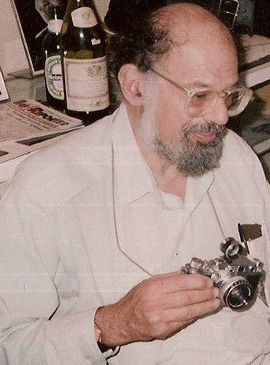
Allan Ginsberg almost always had a camera
The 21st century seems to be heightening the importance of the camera itself. The main aspect of the modern camera is its size, portability and internet capability, allowing it to become the memory and projection device of our personal perspective – the very ‘substance’ of our selves.
It is this technology that drives my thinking – that the self is a point of perspective comprised of the information (images) received at the senses (lens), stored in the memory contained in the body of the device. It is given character by the nature and quality of its component parts; how fast is the chip, how sharp is the lens, how sophisticated the processor. What virtues do you possess?
It is the camera as the lens and projector of the individual self, interconnected to others via the internet, that is the weapon which is taking down governments – at least those governments armed only with guns. The governments armed also with a modern understanding of technology and human psychology seem to be coping quite well, so far. In the heavenly Earth of the future, we will have beaten our swords into cameras. The plowshares will be run by robots.
Every camera has a perspective, depending on where it is, when it is, and in what direction its sensors are pointing. So it is for individual beings. In this story, every person is a perspective, and the number of perspectives is more numerous than the grains of sand in the Ganges. Each grain in its own place, each angle slightly different. Every person is a viewpoint, every citizen a reporter.
In this model, no one perspective is ‘correct’. Each perspective is by its nature slightly or significantly different, as taken from a different vantage point. Each data-set (image, or viewpoint) from any and every perspective can be transmitted and received with relatively equal success, regardless of the quality of the content. Hence, one opinion is seen as being as valid as any other – again, regardless of its quality.
A good example is climate-change denial. What matters in this case is the number of transmissions and mirrored repetitions of the perspective, not whether it is ‘true’ or not. In this view, climate change denial is not a lie, it is merely a different perspective. In this world as Burroughs predicted, nothing is true and everything is permitted (to be a truth).
***
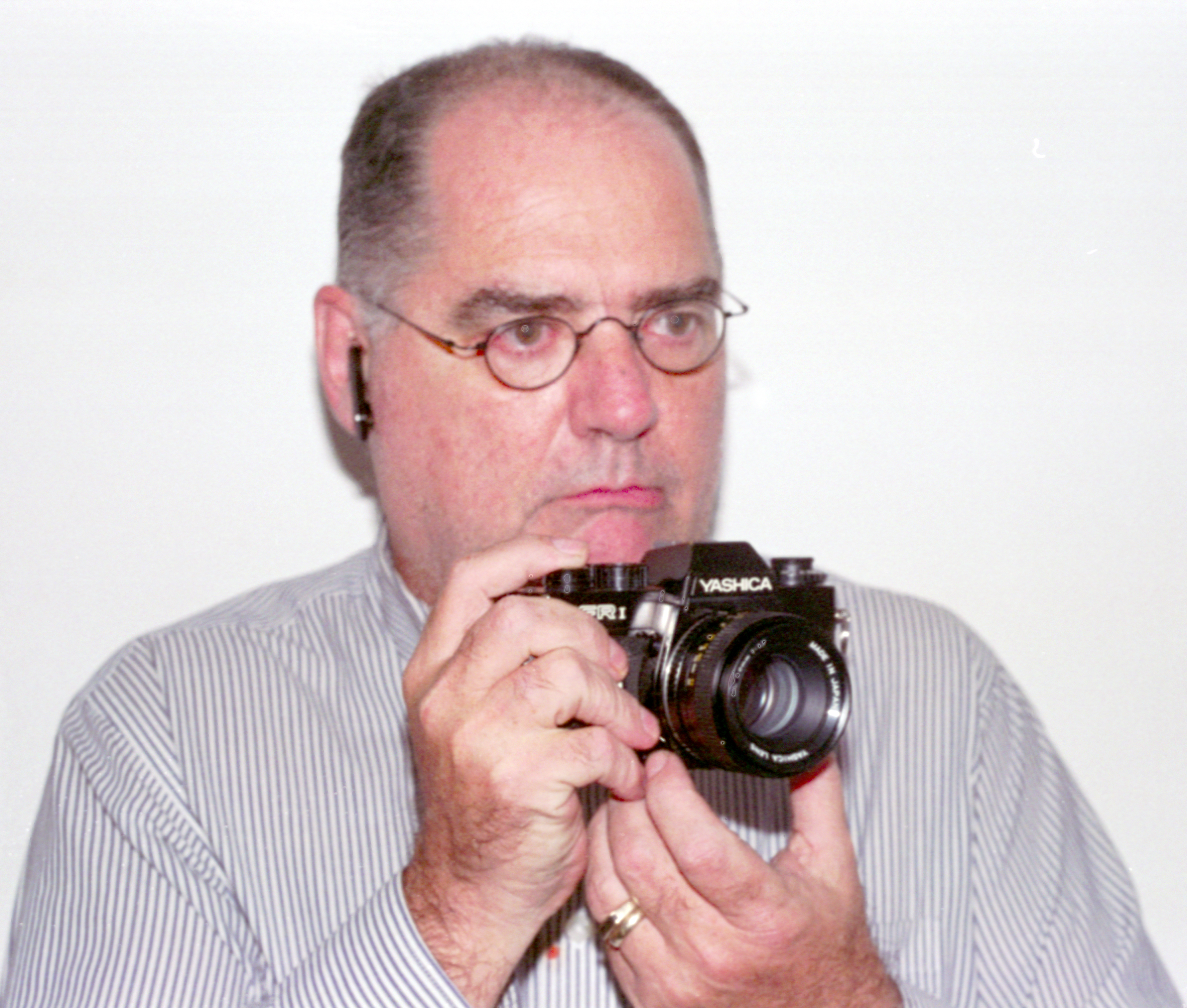
The author almost always has a camera
In what other way can I tell myself the story of what is, except with the information available to my place and time? With what other techniques can I employ to craft that story other than those favored by the current technology – that which is at hand?
So I suggest that the self is a perspective that changes with the movement of the sensors, its self-awareness is its memory, its duration is as long as the device holds out – until the device ‘dies’. Should a comprehensive data set survive as a coherent ‘body of work’, preserved as art or merely as a personal archive in the techno-cloud, some kind of immortality will have been achieved, not of the device, but of the perspective. (Neither Da Vinci or Shakespeare survive, but we ‘know’ them through their surviving perspective.)
***
 The common term that has developed for on-line storage of our data is ‘the cloud’.
In an old story, God exists above the clouds, speaks from the clouds, and we, users and believers, shall be called up together in the clouds.
It is our latest technique for immortality.
Like it? Tip it! http://smalagodi.tip.me
What Do We Want?
It has been a while between posts, hasn’t it? I am not an industrious writer. I do not produce on an industrial scale. And I don’t like writing. It codifies a perspective when the perspective naturally defies codification.
 Nevertheless, I did find myself thinking about posting, and an email from a reader (I didn’t know there were any!) has prompted this post.
Steve M. wrote for my take on the Occupy movement, about which he writes that it is exciting but “on the other hand seems to be filled with wage slaves who want to slave for slightly higher wages. The idea of opting out and having a life, not a job, as you like to say on this blog, doesn’t really get explored.”
In this M. is echoing a sentiment expressed by the very industrious writer James Kwak at Baseline Scenario in his post Straight Out of Antiquity. Mr. Kwak rightly discerns the median demands of OWS as [hopelessly] bourgeois, the word finally appearing in his last paragraph.
He cites an analysis of the OWS Tumblr postings by Mike Konczal : “As his numbers indicate (and my reading of a decent chunk of the pages confirms), there aren’t many extravagant ambitions here: no expectations of material consumption, no expectations of self-actualization through work, no 60s-style dreams of peace and community.”
I would say that this is both accurate and to be expected. First because any look at the signage or internet postings of this amorphous group as a whole will give you only an overall view which, by the nature of the inquiry will give a median result. Within the framework of the data one is likely to find boundaries that range from the mundane (jobs and debt relief) to the slightly more ambitious (universal health care) to the impossible (ending corruption). This is entirely consistent with the mainstream aspirations of everyday people. I do not recall seeing the demands of demonstrators in Egypt, Greece, Spain or London for anything more radical. No calls for flower power.
Again, this is entirely consistent with a sentiment that I believe is at least instinctually understood by ‘the masses’; (as I have said before) “Capitalism is killing us, Socialism can’t save us, and no one knows what happens next.”
Those of us with the luxury of time for intellectual pursuits such as this one, like me and Mr. Kwak, naturally look at a wider set of issues in a longer time frame. We understand that the real-world pressures on the capitalist industrial system that are driving events will not, and can not be mitigated by the old regime of industrial capitalism and nation-state proxies. We understand that the human future – if there is one – will require a complete reworking of both the economic and political structures, accompanied by a complete reworking of individual human aspirations. It is only when the aspirations of people align with the actual demands and limitations of their environment can any kind of stability or modicum of satisfaction be achieved.
This mismatch between aspiration and possibility is what drives all social movements. It is quite natural that ~on aggregate~ the aspirations of ‘the masses’ are bourgeois and mundane. Materialism is the only ideology that most have ever known. The spread of consumerism worldwide through economic policy and mass media completely dominate the zeitgeist. There simply is no vision from the Left or the Religious Humanists that is both concentrated and coherent.*
But fear not. The consumerism that destroyed my generation (the Vietnam generation) is not available for this current generation. Try as they might, the industrialists may try to sustain their growth profits by exploiting every last molecule of carbon energy in Chinese factories, but it cannot work for very long. There will be a cataclysmic restructuring. Will this be preceded by the usual resource war? I hope not.
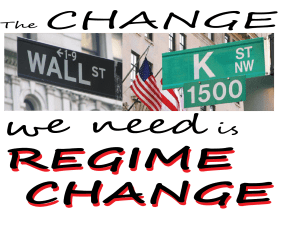
When we look at the campaign rhetoric of Mr. Obama, ‘no more business as usual’, ‘ending the tyranny of oil’, and so on as actual expressions of popular will – which I believe they are; the ‘change we can believe in’ – we can see that to accomplish these things in America will require what people everywhere have called for but have not realized anywhere as yet; regime change. A regime is a method, a standard practice. People in Egypt have not gotten regime change, they’ve gotten personnel change.
When we see the signs among the occupiers for REGIME CHANGE, such as I offer above, we will know that the stakes have been properly raised, and the struggle will get ugly.
Even so, I’m with them all the way. They are my dear, beloved bourgeois brothers and sisters.
———————————————–

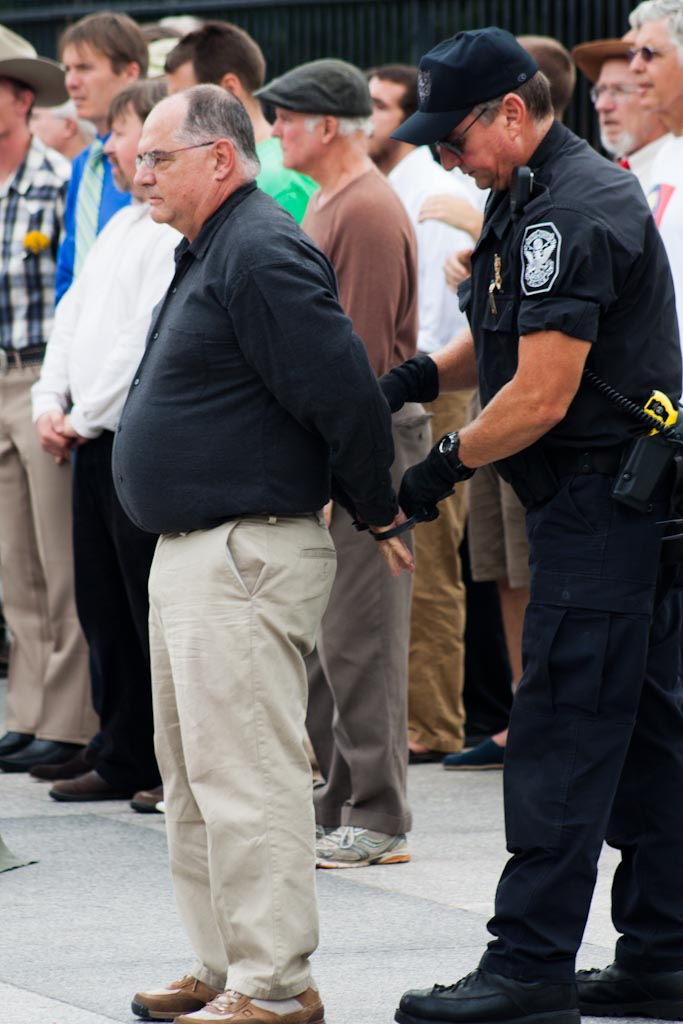
*I had the good fortune, after my arrest in Washington at the Tar Sands / Keystone XL ‘sit in’, to find myself in the back of the police van with a number of religious leaders, the most interesting among them being Fr. Paul Mayer, a colleague of the Berrigans. We had a wonderful time discussing the Berrigan brothers, the nature of civil disobedience and the moral underpinnings of direct action if it is not to degenerate into a useless exercise of hatred and division. I presented my controversial comparison of the guidance of Thomas Merton and Philip Berrigan with the ‘guidance’ of Chris Hedges and Bill Maher, much to the discomfort of my fellow passengers. The difference is one of compassion (to suffer or feel together) versus one of division and retribution.
Like it? Tip it! http://smalagodi.tip.me




 Pax Lupo
Forest and Factory
The Three Jewels.
What does the word ‘refuge’ mean?
I take refuge in the Buddha who shows me the way.
The way through the forest is not the same as the way through the factory.
I take refuge in the Dharma of wisdom and understanding.
The Dharma is the wisdom of all time. This is our particular time.
I take refuge in the Sanga, with harmony and peace.
I wish you well.
Cultivate compassion where there is no water or soil.
The landscape is a dust bowl.
“A noble effort, doomed, but the only choice.” ~Giorno
“We’re lost in a Roman wilderness of pain.”

One cannot take refuge and brave the storm at the same time.
Like it? Tip it! http://smalagodi.tip.me
Share this: